Restricted Access
This website is intended strictly for qualified research professionals. All products are sold for in-vitro laboratory research use only and are not intended for human or veterinary use.
Statements have not been evaluated by the U.S. Food and Drug Administration. Products are not intended to diagnose, treat, cure, or prevent any disease. Janera Science is not a 503A compounding pharmacy or 503B outsourcing facility.


Date
Category
cGMP is a set of enforceable manufacturing regulations, and the FDA is explicit that they establish a floor rather than a standard of excellence. The agency states that "CGMP regulations for drugs contain the minimum requirements" (U.S. Food and Drug Administration).
That single sentence reframes how the term should be read on a supplier's website. This article covers what the letters mean, what the regulations actually require, why the "current" is doing real work, and where materials supplied for laboratory research sit relative to any of it.
All Janera Science compounds are supplied strictly for in-vitro laboratory research use only. They are not for human or veterinary use and have not been evaluated by the FDA.
What the Letters Stand For
cGMP means Current Good Manufacturing Practice, and it refers to regulations the FDA enforces. In the agency's own words, "CGMP refers to the Current Good Manufacturing Practice regulations enforced by the FDA" (U.S. Food and Drug Administration).
What the regulations govern is systems rather than outcomes. The FDA describes their function directly: cGMP "provides for systems that assure proper design, monitoring, and control of manufacturing processes and facilities" (U.S. Food and Drug Administration).
Design, monitoring and control are the three words worth holding onto. The framework is not a test a batch passes. It is a description of how a facility is required to operate so that batches come out the same way each time.
The "current" is not decoration
The leading letter carries a requirement of its own. The FDA states that "the 'C' in CGMP stands for 'current,' requiring companies to use technologies and systems that are up-to-date" (U.S. Food and Drug Administration).
This is why the standard cannot be satisfied once and then held. A facility operating to the analytical and control technology of a decade ago may have met the requirement then and fail it now, without changing anything, because the expectation moved.
It also means the phrase describes an ongoing operating condition. A claim about it is a claim about how a facility is running today.
What the Regulations Require in Practice
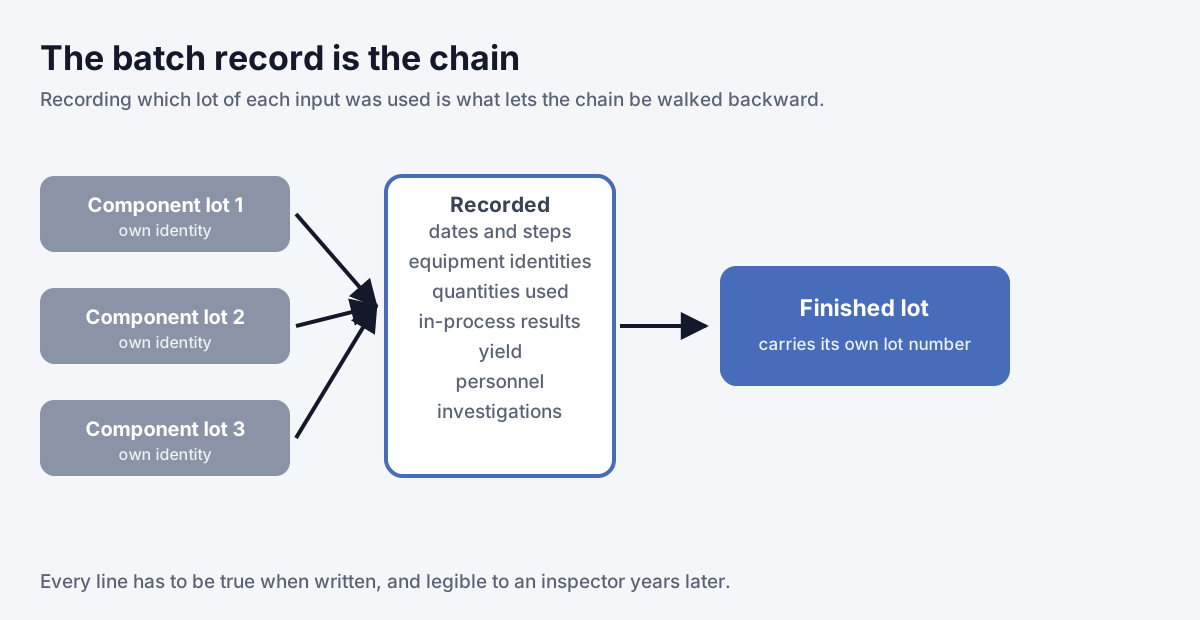
The systems language becomes concrete in the record-keeping requirements. Federal regulation requires that "batch production and control records shall be prepared for each batch of drug product produced and shall include complete information relating to the production and control of each batch" (21 CFR 211.188).
Those records must document that each significant step was accomplished, and the required contents are specific:
Required in a batch record | What it establishes |
|---|---|
Dates of completion for each step | When the work happened |
Equipment and line identities used | Which physical assets touched the material |
Batch identification of components used | What went in, traceable to its own lot |
Weights and measures of components | The quantities actually used, against those planned |
In-process and laboratory control results | What was measured during production |
Actual yield and percentage of theoretical yield | Whether the run behaved as expected |
Identification of personnel performing each step | Who is accountable |
Any investigations conducted | What went wrong and what was concluded |
Read as a list this is unremarkable. Read as a system it is demanding, because every line has to be true at the time it is written and has to survive an inspector reading it years later. Our guide to batch traceability covers what that record chain makes possible after the fact.
GMP and cGMP: the Same Framework, Differently Named
The two abbreviations are used almost interchangeably, and the distinction that matters in a United States regulatory context is the letter at the front.
Good Manufacturing Practice is the general concept: the principle that medicines and related products should be produced under controlled, documented, repeatable conditions rather than left to the care of whoever happens to be running the process. It is a widely used phrase and appears in regulatory frameworks internationally.
Current Good Manufacturing Practice is the name the FDA uses for its own enforceable regulations. The agency's framing is specific on this point, describing CGMP as referring to "the Current Good Manufacturing Practice regulations enforced by the FDA" (U.S. Food and Drug Administration).
So the practical reading is that GMP names the idea and cGMP names the United States regulatory implementation of it, with the currency requirement attached. A supplier writing "GMP" and a supplier writing "cGMP" may mean the same thing, or may not, and neither abbreviation on its own identifies which facility or which jurisdiction is being referred to.
That ambiguity is the reason the follow-up question is worth asking. The phrase alone does not distinguish between a facility operating under FDA-enforced regulations, a facility operating to a comparable framework elsewhere, and a supplier using the term loosely. Only naming the facility and its regulatory status separates those cases, and they are materially different claims.
Where Research Materials Sit
The regulations govern drug products. Materials supplied under a research use only designation are not drug products, so the framework does not automatically apply to them.
This is a scope fact rather than a loophole. A drug product is manufactured for administration to a person, and the regulatory apparatus exists because of that administration. A compound supplied to a laboratory for in-vitro work is not administered to anyone, which is the entire basis of the research use only designation. Our guide to what Research Use Only means covers the framework in detail.
Two things follow, and they pull in opposite directions.
A research supplier is not obliged to operate to cGMP. Nothing in the designation requires it, and a supplier that does not claim it is not falling short of an obligation.
A supplier that does claim it has made a specific, checkable assertion. The claim is about a facility, an operating condition, and an enforceable regulatory framework. It is exactly the sort of statement that can be evidenced, and therefore exactly the sort a researcher is entitled to ask about.
What evidences the claim
A cGMP claim is not self-supporting, and a badge on a page is not evidence of one. What substantiates it is documentation about the facility: which facility manufactured the material, what its regulatory status is, and what inspection or audit history stands behind that status.
This is a different kind of question from the ones a certificate of analysis answers. A COA reports measurements on a finished lot. A manufacturing-standard claim describes the conditions under which lots are produced at all, so a stack of clean COAs neither establishes it nor refutes it.
The useful question for a researcher is therefore narrow: which facility, and what evidences its status. A supplier able to answer that has made a claim worth weighting. A supplier that answers with the phrase again has not.
How This Connects to What You Can Actually Verify
Manufacturing standard and analytical documentation are two separate axes, and only one of them is checkable from a browser.
Analytical documentation is verifiable directly. A lot number on a vial should lead to a document reporting measurements on that lot, and the methods behind those measurements should be named. That is the axis a researcher can settle alone, in about a minute, and it is set out on our page covering how we test.
Manufacturing status is verifiable only by asking, because it concerns a facility rather than a vial. That does not make it unimportant. It makes it a question to put to a supplier directly rather than a claim to accept from a page.
Holding those two apart is the practical skill. It stops a strong analytical record from being read as evidence for a manufacturing claim, and it stops a manufacturing claim from standing in for measurements that were never reported.
Frequently Asked Questions
What does cGMP stand for?
Current Good Manufacturing Practice. The FDA describes it as referring to "the Current Good Manufacturing Practice regulations enforced by the FDA" (U.S. Food and Drug Administration).
Is cGMP a certification a company receives?
It is a set of regulations a facility is required to operate under, enforced through inspection. No certificate is awarded on completion. The FDA is explicit that the regulations "contain the minimum requirements".
Why is there a "c" at the front?
Because the requirement is to be current. The FDA states the "C" requires companies "to use technologies and systems that are up-to-date", so a facility can fall out of compliance as expectations advance.
Do research use only compounds have to be made under cGMP?
No. The regulations govern drug products manufactured for administration. Materials supplied for laboratory research fall outside that scope.
How can a buyer check a cGMP claim?
By asking which facility manufactured the material and what evidences its regulatory status. The claim concerns a facility rather than a batch, so certificates of analysis cannot confirm it.
Does cGMP mean the material is higher purity?
No. The framework governs how consistently a process is designed, monitored and controlled. Purity is established by analysis of the finished lot, which is a separate measurement reported on a certificate.
Key Takeaways
cGMP means Current Good Manufacturing Practice, and the FDA states plainly that the regulations "contain the minimum requirements" (U.S. Food and Drug Administration).
The framework governs systems, specifically the "design, monitoring, and control of manufacturing processes and facilities". The properties of any individual batch are established separately, by analysis.
The "current" imposes an ongoing obligation to use up-to-date technologies and systems, so compliance describes how a facility runs now.
Federal regulation requires a batch production and control record for every batch, carrying dates, equipment identities, component lot identities, quantities, in-process results, yields, personnel and investigations (21 CFR 211.188).
Research use only materials are outside the scope of the regulations, so a supplier claiming cGMP is making a specific facility-level assertion that certificates of analysis cannot evidence either way.
All Janera Science compounds are supplied strictly for in-vitro laboratory research use only. They are not for human or veterinary use and have not been evaluated by the FDA.
Review the Documentation
Analytical documentation is the axis a researcher can check independently. Every currently available compound is listed with its lot number and certificate on the lab results page, and the methods behind each lot are set out on how we test.