
Date
Category
Synthesis impurities in research peptides are the small set of related molecules that sit alongside the target sequence in a finished vial. When a Certificate of Analysis reports 98 to 99 percent purity, that leftover 1 to 2 percent is a defined mixture of chemical relatives produced during assembly of the peptide, each one traceable to a specific step that did not go perfectly.
Understanding what fills that 1 to 2 percent is the difference between reading a purity number and understanding it. The impurities are the reason two vials with the same headline purity can behave differently in a research model. This article stays on the chemistry: what each impurity class is, the synthesis step that creates it, and how it is detected.
At Janera Science, a purity figure is only meaningful when the profile behind it is understood. The impurity classes below are the vocabulary of that profile.
What the Missing 1 to 2 Percent Actually Contains
A synthesis impurity is a molecule produced during peptide assembly that differs from the target sequence in length, chemistry, or three-dimensional structure. It is a close chemical relative of the intended peptide, generated internally by the same reactions that build the correct molecule. That internal origin sets it apart from outside contamination such as dust or residual solvent.
Most research peptides are built by solid-phase synthesis, which adds one amino acid at a time to a growing chain anchored on a resin. Each cycle involves a coupling step and a deprotection step. Every impurity class in this article comes from one of those steps behaving imperfectly on a fraction of the chains.
Purity is a percentage of peak area
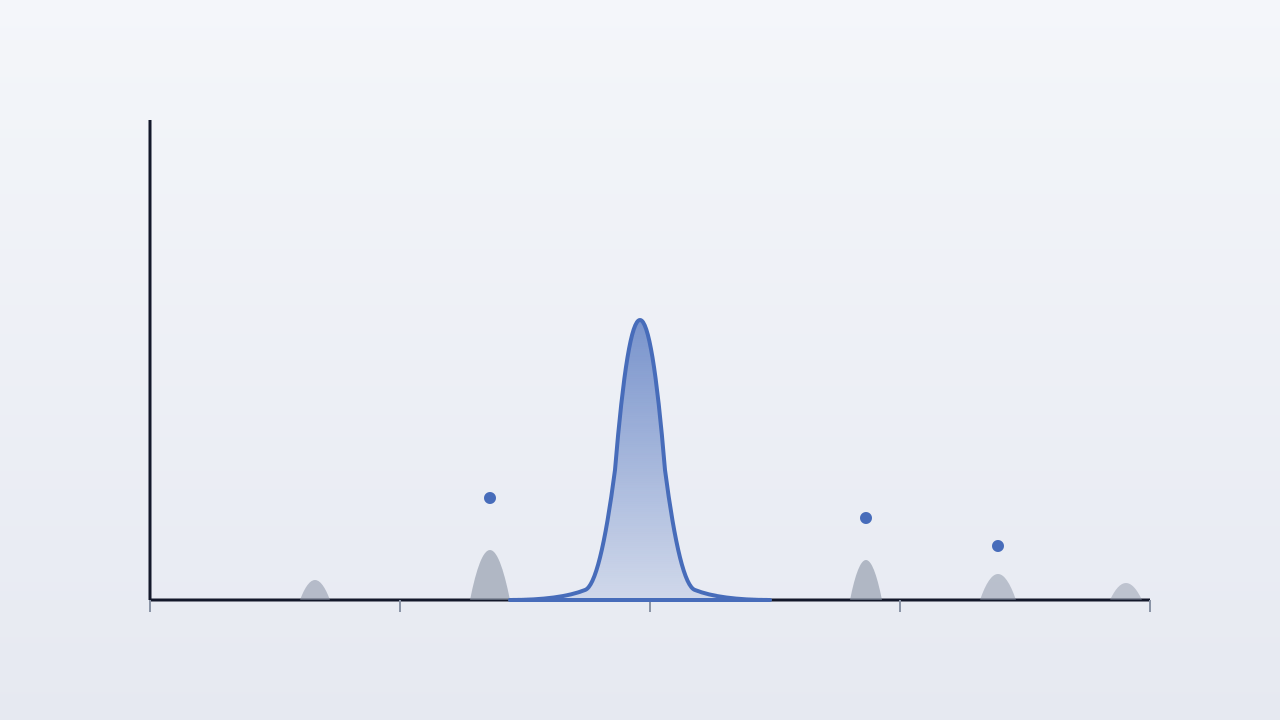
The purity number on a Certificate of Analysis comes from high-performance liquid chromatography (HPLC). The instrument separates the molecules in a sample and records each as a peak. Purity is reported as the area of the main peak divided by the total area of all peaks, expressed as a percentage.
A 98 percent result means the target peptide accounts for 98 percent of the detected material by peak area. The remaining 2 percent is distributed across the impurity peaks. Reading a profile means asking what those smaller peaks are and how large each one is. Our guide to reading a COA walks through where these figures appear.
Why impurities are a reproducibility variable
Impurities matter because they introduce variation between lots. A lot with a 1.5 percent oxidized fraction and a lot with a 0.3 percent oxidized fraction are not identical inputs, even when both round to 98 or 99 percent pure. In an in-vitro research model, that difference is a variable that can shift a measured result.
This is why impurity characterization sits at the centre of quality work. The goal is a defined, consistent profile, so that the material a researcher uses this month matches the material they used last month. The table below maps each impurity class to its cause and its analytical signature.
Impurity class | Synthesis step | What changes | Detected by |
|---|---|---|---|
Truncated sequence | Coupling failure, then capping | Chain ends early | HPLC and MS |
Deletion sequence | Incomplete deprotection | One internal residue missing | HPLC and MS |
Oxidation product | Exposure to oxygen | Added oxygen (+16 Da) | MS |
Racemized residue | Base-driven coupling | One residue flips to D-form | HPLC, chiral analysis |
Aspartimide and beta-peptide | Base during deprotection | Ring forms at aspartic acid | HPLC and MS |
Diketopiperazine loss | Early deprotection | First two residues cleave off | HPLC and MS |
Scrambled disulfide | Oxidative folding | Wrong cysteine pairing | Orthogonal methods |
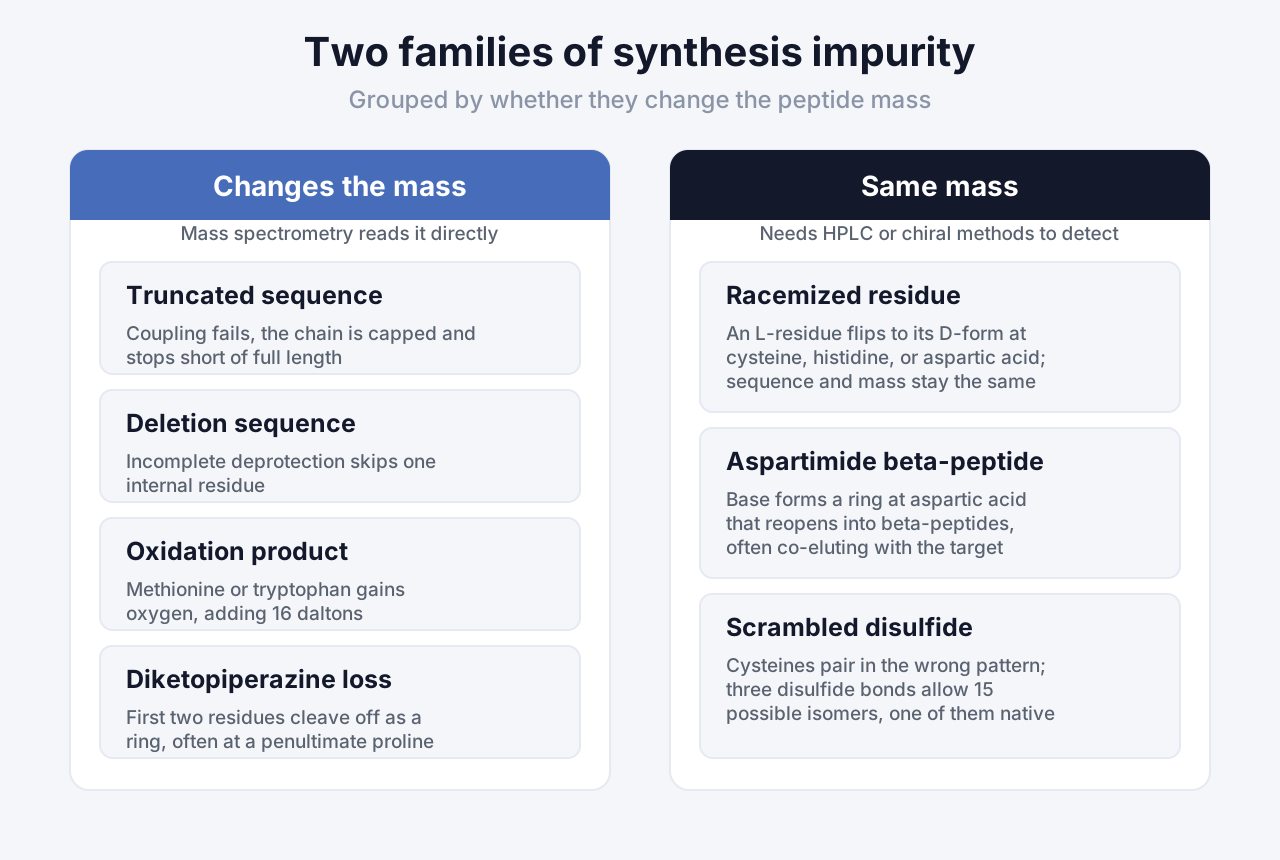
These classes fall into two families. One family changes the peptide's mass, so mass spectrometry reads it directly. The other family keeps the exact mass of the target, which makes it far harder to catch.
Chain-Length Errors: Truncations and Deletions
The most intuitive impurities are the ones where the chain is the wrong length. Two distinct errors produce them, and they come from opposite steps in the synthesis cycle.
Truncated sequences from incomplete coupling
A truncated sequence is a peptide that stopped growing before reaching full length. It forms when a coupling step fails to attach the next amino acid on some fraction of the chains. Those chains still carry a reactive end that would otherwise pick up later residues out of order.
To prevent that, synthesis protocols include a capping step that permanently blocks any chain that failed to couple. A capped chain cannot pick up later residues, so it stays a simple shortened peptide with a clean, defined endpoint. A truncated chain is often much shorter than the full peptide, so it usually differs enough in size to separate cleanly during purification.
Deletion sequences from incomplete deprotection
A deletion sequence is more subtle. It is a peptide missing a single internal amino acid, with the residues on either side joined directly. Deletions trace to incomplete removal of the temporary Fmoc protecting group before the next coupling.
If the protecting group is not fully removed on some chains, the next residue cannot attach at that cycle, yet the chain continues to grow afterward. The result is a full-length-looking peptide short exactly one residue. Incomplete deprotection has been linked to slow or failed coupling at the same positions, with both problems arising from the peptide chain folding into beta-sheet structures that block the reagents (International Journal of Peptide and Protein Research, 1994).
Why deletions are harder to catch than truncations
A truncated chain missing many residues has an obviously different mass and retention time. A deletion missing one small residue such as glycine changes the total mass by only 57 daltons and may shift the retention time very little.
That small difference is why chain-length errors are confirmed with both instruments together. Mass spectrometry (MS) reports the exact mass difference that identifies which residue is absent, while HPLC reports how much of the deletion is present. Neither measurement alone tells the full story.
Chemical Modifications: Oxidation of Methionine and Tryptophan
Some impurities have the correct sequence and the correct length, yet carry a chemically altered side chain. Oxidation is the most common example, and it targets two specific amino acids.
Methionine sulfoxide
Oxidation is the addition of oxygen to a susceptible side chain. Methionine contains a sulfur atom that readily picks up a single oxygen to become methionine sulfoxide. This adds 16 daltons to the peptide, so mass spectrometry detects the product as a peak 16 mass units heavier than the target.
The modification also leaves a diagnostic fingerprint during fragmentation. In collision-induced dissociation, a methionine sulfoxide side chain characteristically loses methanesulfenic acid, a neutral fragment of 64 daltons, which pinpoints the oxidized residue (Journal of the American Society for Mass Spectrometry, 2003). A peptide such as Semax, which carries a methionine at its N-terminus, is a sequence where this class of impurity is worth watching.
Tryptophan oxidation products
Tryptophan is the other oxidation-prone residue, and its chemistry is more varied. Tryptophan can oxidize into several distinct species at once, including hydroxytryptophan, oxindolylalanine, kynurenine, and N-formylkynurenine.
Each of these carries a different mass shift, so mass spectrometry can distinguish them by the size of the added mass (Journal of Mass Spectrometry, 2011). Oxidation can also occur during sample handling and even during the measurement itself, so a well-run analysis distinguishes oxidation built into the lot from oxidation introduced at the bench. This distinction is one reason HPLC and mass spectrometry are run together under controlled conditions.
Stereochemistry and Ring-Formation Side Reactions
The hardest impurities to detect are the ones that share the target peptide's exact mass. Three side reactions produce them, and each involves the chemistry of a specific residue reacting with the basic conditions used during synthesis.
Racemization at sensitive residues
Racemization is the conversion of a natural L-amino acid into its mirror-image D-form. The peptide keeps the same sequence and the same mass, yet one residue now has the wrong three-dimensional orientation, which can change how the molecule folds and binds in a research model.
A small set of residues is especially prone to this. Cysteine, histidine, and aspartic acid were all shown to racemize during synthesis of a model peptide containing every natural amino acid, and lowering the coupling temperature reduced the effect (Journal of Peptide Science, 2007). Histidine is vulnerable because a nitrogen in its ring speeds the reaction that flips the residue.
Aspartimide and beta-peptide formation
Aspartimide formation is a ring-closing side reaction at aspartic acid. Under the basic conditions used to remove protecting groups, the backbone can attack the aspartic acid side chain to form a five-membered ring, which then reopens into a mixture of products.
The reopened products include beta-peptides, where the chain now runs through the side chain instead of the normal backbone position, along with racemized forms. These beta-aspartyl peptides typically form in a three-to-one ratio over the normal product at affected sites and are notoriously difficult to separate, because they share the target's mass and often its retention time (ChemBioChem, 2025). The reaction is strongest at specific pairings such as aspartic acid followed by glycine.
Diketopiperazine formation
Diketopiperazine formation is an early-stage loss that removes the first two residues of a chain. When the second amino acid is deprotected, its freed end can curl back and attack the bond holding the chain to the resin, cleaving off the first two residues as a stable six-membered ring.
The reaction is most prevalent when proline sits as the second residue, and it truncates that chain before it can grow further (ACS Omega, 2022). The surviving material is missing the mass of those two residues, a signature that mass spectrometry reads directly.
Disulfide Errors: Scrambled and Mismatched Bonds
Peptides that contain more than one cysteine face a distinct problem during the folding step, where cysteines pair up to form disulfide bonds. The correct peptide has a specific pairing pattern, and any other pattern is an impurity with identical mass.
Why the isomer count grows quickly
The number of possible pairings rises sharply with each added bond. A peptide with six cysteines forming three disulfide bonds can adopt 15 distinct isomers, only one of which is the intended structure (Chemical Science, 2025). Inefficient folding increases the chance that some chains lock into a non-native, scrambled pattern.
Detecting a same-mass structural difference
A scrambled disulfide has the same molecular formula and the same mass as the correct peptide. Mass spectrometry alone cannot separate them, because there is no mass difference to measure. Resolving these isomers requires orthogonal methods that respond to shape and connectivity, such as chromatographic separation combined with targeted fragmentation. This is the clearest case where a single analytical technique falls short.
How HPLC and Mass Spectrometry Read the Impurity Profile Together
The impurity classes above fall into two groups, and the split explains why quality analysis pairs two instruments. Some impurities differ from the target in mass, and some do not.
HPLC answers the question of how much. It separates the sample into peaks and measures the area of each, which is where the purity percentage comes from. It resolves impurities that travel differently through the column, including many truncations, deletions, and oxidation products.
Mass spectrometry answers the question of what. It measures exact mass, which identifies a deletion by the residue that is missing, an oxidation by its added 16 daltons, or a diketopiperazine loss by the mass of the cleaved ring.
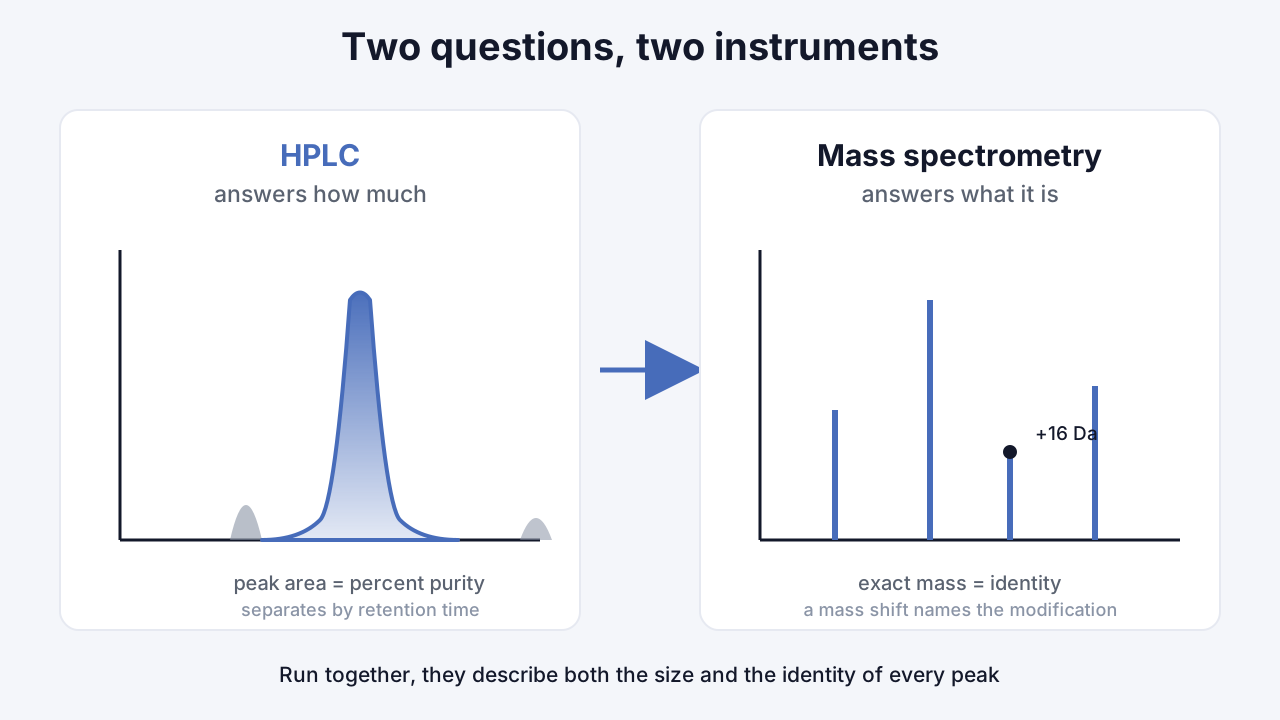
The two techniques cover each other's blind spots. A same-mass impurity such as an aspartimide beta-peptide can slip past MS yet show a distinct HPLC behaviour, while a co-eluting oxidation product that HPLC misses is caught by its mass shift. Run together, HPLC and mass spectrometry describe both the size and the identity of every peak in the profile.
That combined profile is what appears on a lot-specific Certificate of Analysis. Each lot supplied by Janera Science is tested this way, and the results are published on the lab results page for review. Consistent quality verification is the standard every research supplier should hold itself to.
Every compound discussed here is supplied strictly for in-vitro laboratory research. Our research use only framework sets out what that means and who may purchase.
Frequently Asked Questions
What are the main impurities in a synthetic peptide?
The main synthesis impurities are truncated sequences from incomplete coupling, deletion sequences missing one residue from incomplete deprotection, oxidation products at methionine and tryptophan, racemized residues, aspartimide and beta-peptides, diketopiperazine losses, and scrambled disulfides in multi-cysteine peptides. Each traces to a specific step in solid-phase peptide synthesis.
What does 98 percent purity mean for a research peptide?
It means the target peptide accounts for 98 percent of the detected material by HPLC peak area, and the remaining 2 percent is a defined mixture of synthesis-related impurities. Purity is calculated as the main peak area divided by the total area of all peaks (International Journal of Peptide and Protein Research, 1994). The value describes composition, and the profile behind it describes which impurities are present.
What is the difference between a truncated and a deletion peptide?
A truncated peptide stopped growing early and is missing everything past a certain point, usually because a coupling step failed and the chain was capped. A deletion peptide is full length except for one internal residue that was skipped, usually from incomplete Fmoc deprotection. Truncations are generally easier to remove because they differ more in size.
How is peptide oxidation detected?
Oxidation is detected by mass spectrometry, which reads the added oxygen as a mass increase of 16 daltons for methionine sulfoxide. Methionine sulfoxide also shows a diagnostic loss of 64 daltons during fragmentation (Journal of the American Society for Mass Spectrometry, 2003). Tryptophan oxidation produces several products, each with its own mass shift.
Why do some impurities have the same mass as the target peptide?
Racemized residues, aspartimide beta-peptides, and scrambled disulfides all keep the same atoms as the target, so their mass is identical. Racemization flips a residue to its mirror form, aspartimide reroutes the backbone, and disulfide scrambling changes which cysteines are paired. Mass spectrometry cannot separate them by mass, so they require chromatographic or chiral methods to detect.
Do synthesis impurities affect research results?
Synthesis impurities are experimental variables that can differ between lots, which is why a defined, consistent impurity profile matters for reproducibility in research models. Two lots with the same headline purity can carry different impurity fractions. Characterizing the profile with HPLC and mass spectrometry is how a supplier keeps that variable controlled.
Key Takeaways
The 1 to 2 percent behind a 98 to 99 percent purity figure is a defined set of synthesis impurities, and each class traces to a specific step in solid-phase synthesis.
Chain-length errors split into truncations and deletions, where truncations stop the chain early through capping and deletions skip one internal residue from incomplete deprotection (International Journal of Peptide and Protein Research, 1994).
Oxidation adds 16 daltons at methionine and produces several products at tryptophan, all read by mass spectrometry through their mass shifts (Journal of Mass Spectrometry, 2011).
Racemization, aspartimide, and diketopiperazine formation are the hardest impurities to detect because racemized and beta-peptide products share the target's exact mass (ChemBioChem, 2025).
HPLC measures how much and mass spectrometry measures what, and only the two together resolve both same-size and same-mass impurities across the full profile.
All Janera Science compounds are supplied strictly for in-vitro laboratory research use only. They are not for human or veterinary use and have not been evaluated by the FDA.
Every batch verified
Janera Science publishes third-party Certificates of Analysis for its research peptides. To review identity, purity, and analytical verification for current material, visit our lab results page. For the regulatory context behind how these materials are supplied, see our overview of what Research Use Only means.