
Date
Category
Peptide Purity Testing: HPLC and Mass Spectrometry Explained
Two analytical techniques sit at the centre of every credible research peptide certificate of analysis. High-performance liquid chromatography (HPLC) measures how pure the material is. Mass spectrometry (MS) confirms that the material is what it claims to be. Together, they answer the only two questions that matter when evaluating a synthetic peptide for laboratory use: how much of the right thing is in the vial, and is the right thing actually the right thing.
This article explains how each technique works, what the chemistry behind each method actually measures, and how the two are read together to verify a research peptide.
This content is provided for informational and educational purposes only and does not constitute medical, pharmaceutical, or legal advice. The products discussed are intended for laboratory research purposes only and are not for human or animal consumption. They are not intended to diagnose, treat, cure, or prevent any disease.
Why purity and identity are separate questions
Peptide quality cannot be reduced to a single number. The two analytical questions are independent of each other, and a peptide can fail either without failing the other.
A sample can be 99% pure and still be the wrong peptide. The HPLC chromatogram will show a single sharp peak, the purity calculation will return an excellent result, and every interpretation based on that number will be built on a misidentified compound. Purity without identity is misleading.
A sample can be confirmed as the correct peptide and still be unsuitable for research. The mass spectrum will show the expected molecular weight, the identity assignment will be unambiguous, and yet the material in the vial may consist of 70% target peptide and 30% truncated sequences. Identity without purity is incomplete.
The two techniques exist in combination because each one closes the blind spot in the other. HPLC quantifies the proportion of target material but cannot prove what that target material is. Mass spectrometry confirms identity but cannot, on its own, quantify what fraction of the sample is the identified compound. The certificate of analysis is the document that brings the two readings together.
What HPLC measures and how it works
High-performance liquid chromatography is a separation technique. It distinguishes the components of a mixture by passing them through a packed column under high pressure and detecting them as they emerge at characteristic times.
For research peptides, the standard variant of the technique is reverse-phase HPLC (RP-HPLC). The technique has been the dominant method for peptide purification and analytical characterization since the late 1970s (Wiley, 2006).
The separation principle
In RP-HPLC, the stationary phase is a column packed with silica particles whose surfaces have been chemically modified with hydrophobic alkyl chains, most commonly C18 (octadecylsilane). The mobile phase is a mixture of water and an organic solvent such as acetonitrile, usually containing a low concentration of an ion-pairing agent like trifluoroacetic acid.
When a peptide sample is injected onto the column, hydrophobic regions of the peptide bind reversibly to the hydrophobic stationary phase. The peptide is then eluted by gradually increasing the proportion of organic solvent in the mobile phase. As the mobile phase becomes more hydrophobic, it competes more effectively with the column for the peptide, and the peptide is released (ScienceDirect, n.d.).
Components elute in order of increasing hydrophobicity. Two peptides that differ even by a single amino acid substitution typically differ in hydrophobicity, and therefore in retention time. This is why HPLC can separate the target peptide from closely related synthesis impurities such as deletion sequences (missing one amino acid) or oxidation products (where a methionine or tryptophan has been oxidized).
Detection and the chromatogram
As components emerge from the column, they pass through a detector. For peptides, the standard detection method is ultraviolet (UV) absorbance at 214 nm or 220 nm, where the peptide bond absorbs strongly.
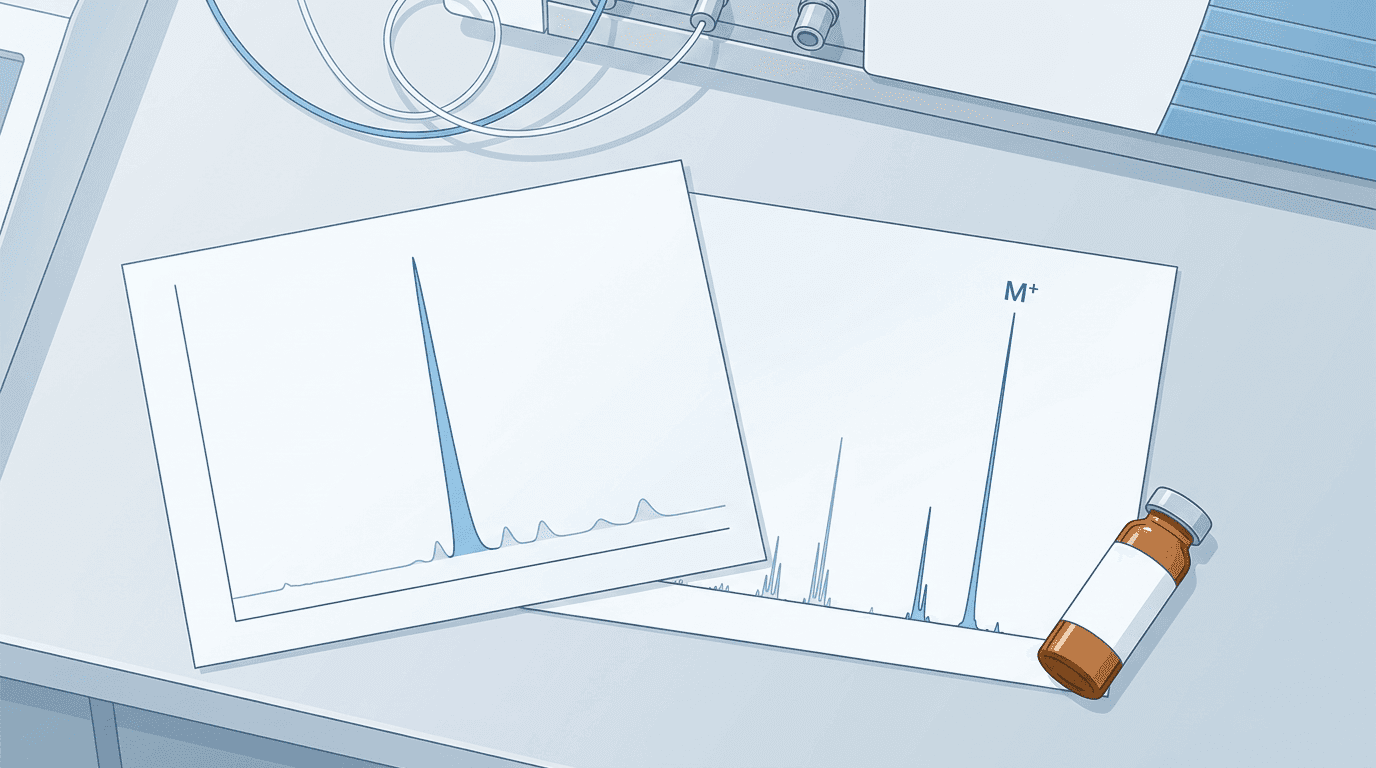
The output is a chromatogram: a plot of detector signal against time. Each peak represents a component eluting from the column at a particular retention time. The key features for purity testing are:
Retention time of the main peak, which serves as a fingerprint that can be compared across batches
Peak area for each peak, integrated by software to estimate the amount of each component present
Area-percent of the main peak, calculated as (target peak area / sum of all peak areas) × 100. This is the value reported as the HPLC purity (PeptidesSource, 2026)
A high-purity peptide chromatogram shows one dominant, sharp peak at the expected retention time, with only minor satellite peaks. Broad peak shapes, multiple peaks of comparable height, or significant baseline drift all indicate problems with the synthesis, the purification, or the analytical method itself.
What HPLC purity actually means
The most important conceptual point about HPLC purity, and the one most often misunderstood: the percentage refers to UV-absorbing material, not to total mass.
A result of 98.5% area means that 98.5% of the UV-absorbing material detected in the run corresponds to the target peptide. It does not mean that 98.5% of the mass in the vial is the target peptide. Counter-ions, water, and residual solvents are UV-transparent and do not appear in the chromatogram at all. A vial with 98.5% HPLC area purity can still contain only 80% target peptide by net mass once water and counter-ion content are accounted for. This is why the certificate of analysis must also report net peptide content separately, as covered in the companion article on reading a peptide COA.
The blind spots of HPLC
HPLC is a powerful technique with two specific limitations that mass spectrometry is needed to address:
Co-elution. Two different molecules with similar hydrophobicity can elute at the same retention time, appearing as a single peak. Without an orthogonal identity check, co-eluting impurities can hide under the main peak and inflate the apparent purity (PeptidesSource, 2026).
No identity confirmation. HPLC tells you that a single dominant species is present. It cannot tell you what that species is. The peak at 12.4 minutes might be the target peptide, or it might be something else that happens to elute at the same time on this particular column.
For pharmacopoeial work, the response to co-elution is to use orthogonal methods: two different HPLC methods with different separation mechanisms, so that any co-elution under one set of conditions is exposed by the other. United States Pharmacopeia General Chapter <1225> sets the validation requirements for analytical procedures, including specificity tests designed to detect co-elution (PolyPeptide, 2019).
What mass spectrometry measures and how it works
Mass spectrometry answers the identity question that HPLC cannot. It measures the mass-to-charge ratio (m/z) of ionized molecules and uses that measurement to determine molecular weight with high accuracy.
The general principle
A mass spectrometer performs three operations in sequence:
Ionization. Neutral peptide molecules are converted into gas-phase ions. Most peptides will not survive harsh ionization, so peptide MS uses soft ionization techniques that produce intact molecular ions without fragmenting them.
Mass analysis. The ions are separated according to their mass-to-charge ratio in a mass analyzer (typically time-of-flight, quadrupole, ion trap, or hybrid configurations).
Detection. A detector converts the ion signal into electrical output, producing a mass spectrum: a plot of ion intensity against m/z.
For a peptide of known formula, the theoretical monoisotopic mass can be calculated from the molecular formula. The observed mass from the mass spectrum is compared to the theoretical mass. A match within instrument tolerance confirms identity. A mismatch indicates either a different compound, a modification (oxidation, deamidation, incomplete deprotection), or an instrument calibration issue.
Electrospray ionization (ESI)
Electrospray ionization is the workhorse ionization technique for peptide analysis when MS is coupled to a liquid chromatography front end. In ESI, the eluent from an HPLC column is pumped through a fine capillary held at high voltage. The voltage produces a fine spray of charged droplets, which evaporate to yield gas-phase peptide ions.
ESI has two characteristics that matter for peptide work:
Multiple charging. ESI tends to produce ions carrying multiple charges, especially for larger peptides. A peptide with a molecular weight of 3,000 Da might appear in the spectrum as [M+2H]²⁺ at m/z 1,501 and [M+3H]³⁺ at m/z 1,001 simultaneously. This extends the effective mass range of the instrument and increases sensitivity (Verified Peptides, 2025).
LC-MS compatibility. Because ESI accepts a liquid stream directly, it integrates cleanly with HPLC. The combined technique, LC-MS, lets the chromatographic separation and the mass measurement happen in the same run, removing ambiguity about which peak corresponds to which mass.
Matrix-assisted laser desorption/ionization (MALDI)
MALDI is the alternative soft ionization technique. The peptide sample is mixed with a small-molecule matrix compound that absorbs UV light, co-crystallized on a metal target plate, and ionized by a pulsed laser. The matrix absorbs the laser energy and transfers it to the peptide, producing intact ions while protecting the peptide from direct laser damage.
MALDI has different operational characteristics from ESI:
Single charging. MALDI predominantly produces singly charged ions ([M+H]⁺). This makes the spectrum simpler, one peptide produces one main peak, but also limits the effective mass range of the analyzer.
High throughput. MALDI is a pulsed, plate-based technique. Many samples can be spotted on a single plate and analyzed in quick succession, which suits high-throughput screening.
Bias toward certain peptide classes. MALDI tends to favour smaller, more basic peptides, while ESI provides broader coverage of hydrophobic and larger peptides (J. Proteome Research, 2017; ScienceDirect, 2009).
For research peptide certificates of analysis, either ESI-MS or MALDI-MS is acceptable as an identity confirmation method, provided the observed mass matches theoretical within instrument tolerance. ESI is more common in pharmaceutical and industrial peptide QC because of its direct LC coupling. MALDI is common in academic peptide characterization for the same reason it dominates protein mass mapping: speed and simplicity.
Mass accuracy and instrument resolution
Two parameters describe how trustworthy a mass measurement is:
Mass accuracy. How close the observed mass is to the theoretical mass. For a research-grade peptide on a modern instrument, observed mass typically falls within 0.1 to 1.0 daltons of theoretical for low-resolution instruments, and within a few parts per million for high-resolution instruments such as Orbitrap or FT-ICR analyzers.
Resolution. The ability to distinguish two ions of similar mass. Higher resolution means more confidence that the observed peak is a single species and not an unresolved cluster.
A certificate of analysis that reports an observed mass without specifying instrument type or resolution provides less information than one that does. The qualifier matters because a "match within 1 Da" on a low-resolution instrument is normal, while the same deviation on a high-resolution instrument would signal a problem.
How HPLC and MS work together: LC-MS
The integration of liquid chromatography and mass spectrometry into a single hyphenated technique is the analytical workhorse of modern peptide characterization. LC-MS combines the separation power of HPLC with the identity confirmation of MS in a single run.
The workflow is straightforward in concept:
Sample is injected onto an HPLC column and separated as in a standard HPLC run.
Eluent flows directly into an electrospray ion source rather than (or in addition to) a UV detector.
Ions are formed continuously as components elute, and the mass spectrometer records a mass spectrum at each retention time.
The output is a chromatogram in which each peak is associated with the mass spectrum of the species that produced it.
The advantage is decisive. A peak in a UV chromatogram is just a peak. A peak in an LC-MS chromatogram comes with an identity tag. Co-eluting impurities that would hide under the main peak in a UV trace become visible in the mass spectrum because they have a different mass.
For peptide-related impurity profiling at low levels (in the range of 0.05% to 1% of drug substance), LC-MS using complementary column chemistries has become the recommended approach in pharmaceutical practice (LCGC International, 2026).
For a research peptide certificate of analysis, the practical implication is that a COA documenting both HPLC purity and MS identity is documenting a stronger result if the two measurements came from the same LC-MS run than if they came from separate experiments. Same-run measurements eliminate any ambiguity about whether the main HPLC peak and the mass spectrometry result correspond to the same molecule.
What HPLC and MS together cannot detect
The combination of HPLC and mass spectrometry is the gold standard for peptide chemical purity and identity. It is not a complete safety profile. Three categories of contaminant fall outside what these techniques can detect.
Endotoxin. Bacterial endotoxin (lipopolysaccharide) does not absorb UV at peptide detection wavelengths, does not retain on a C18 column under standard peptide conditions, and does not ionize efficiently under standard peptide MS conditions. A peptide can pass HPLC and MS specifications and still be contaminated with endotoxin if microbiological testing was not performed.
Heavy metals. Trace metal contamination from synthesis reagents or purification equipment is not visible in a UV chromatogram or in a peptide MS spectrum. Detection requires elemental analysis methods such as inductively coupled plasma mass spectrometry (ICP-MS).
Bioactivity differences from chemically identical impurities. Two molecules can have the same mass and very similar HPLC retention behaviour and yet differ in stereochemistry. D-amino acid contamination from epimerization during synthesis is a known and well-studied issue in peptide chemistry. Chiral analysis by amino acid analysis (AAA) with chiral derivatization is required to detect it.
A complete research peptide quality profile uses HPLC and MS as the core analyses and supplements them with bacterial endotoxin testing (per USP General Chapter <85>), residual solvent analysis (per USP <467>), and chiral analysis where stereochemistry is critical to the application (PolyPeptide, 2019).
What a credible analytical method declaration looks like
Beyond the result itself, a certificate of analysis should disclose how the result was obtained. The minimum disclosure for HPLC and MS sections looks like this:
Method element | HPLC | Mass spectrometry |
|---|---|---|
Instrument | Manufacturer and model where possible | Manufacturer, analyzer type, resolution |
Column or source | Stationary phase chemistry, column dimensions, particle size | Ionization mode (ESI / MALDI) and polarity |
Mobile phase or matrix | Composition and gradient or matrix compound | Matrix details if MALDI |
Detection | Wavelength (typically 214 nm or 220 nm) | Mass range scanned |
Result | Area % of main peak | Observed mass, theoretical mass, mass error |
Visual record | Chromatogram | Mass spectrum |
A document that omits the method details and reports only "purity: 98.5%" and "identity confirmed by MS" provides numbers but not evidence. The numbers cannot be independently evaluated, the analysis cannot be reproduced, and the documentation has weak value as a record. Pharmacopoeial work requires that analytical methods be documented in enough detail to be independently reproduced, which is the standard a credible research peptide COA should aim toward.
Frequently Asked Questions
What is the difference between HPLC and mass spectrometry in peptide analysis?
HPLC measures purity by separating the components of a sample and quantifying the proportion of target peptide relative to impurities. Mass spectrometry confirms identity by measuring the molecular weight of the target compound. HPLC answers "how pure is it?" Mass spectrometry answers "is it the right molecule?" The two techniques are complementary, and both are required for a complete peptide characterization (Wiley, 2006).
What HPLC purity threshold is standard for research peptides?
Most research applications require a minimum of ≥98% area by HPLC. Applications involving high-sensitivity assays, structure-function studies, or work intended for publication often require ≥99% purity. Purity below 95% is generally considered inadequate for serious research work, though some specialized applications tolerate lower thresholds.
What is reverse-phase HPLC, and why is it used for peptides?
Reverse-phase HPLC uses a hydrophobic stationary phase (typically C18-modified silica) and a polar-to-less-polar gradient mobile phase. Peptides separate by hydrophobicity, eluting in order of increasing hydrophobic character. The technique has been the dominant method for peptide separation since the late 1970s because it offers excellent resolution for closely related peptide species and works with volatile, MS-compatible mobile phases (ScienceDirect, n.d.).
What is the difference between ESI and MALDI mass spectrometry?
Both are soft ionization techniques used in peptide mass spectrometry. Electrospray ionization (ESI) generates ions from a liquid stream and tends to produce multiply charged ions, integrating directly with HPLC. Matrix-assisted laser desorption/ionization (MALDI) generates ions by laser excitation of a co-crystallized sample-matrix mixture and tends to produce singly charged ions. The two techniques have complementary coverage; large-scale studies have found that fewer than half of detected peptides are seen by both methods on the same sample (J. Proteome Research, 2017).
Can HPLC alone confirm peptide identity?
No. HPLC measures retention time and quantifies separated components, but it cannot confirm what those components are. Two different molecules with similar hydrophobicity can elute at the same retention time. Identity confirmation requires an orthogonal technique, typically mass spectrometry, that measures molecular weight directly.
What does "% area by HPLC" mean on a certificate of analysis?
% area by HPLC refers to the peak area of the target peptide as a percentage of the total area of all peaks detected during the chromatographic run. A result of 98.5% area means 98.5% of the UV-absorbing material detected is the target compound. This is not the same as the mass percentage of peptide in the vial — water, counter-ions, and residual solvents are UV-transparent and not counted in the % area calculation.
Why are both methods needed on a certificate of analysis?
Each technique has a blind spot the other fills. HPLC can quantify purity but cannot confirm identity; MS can confirm identity but cannot reliably quantify purity on its own. A COA reporting only HPLC purity proves the sample is dominated by one species without proving what that species is. A COA reporting only MS identity proves the species is correct without proving the sample is not heavily contaminated. Both readings together are what allow a researcher to use the material with confidence.
Key Takeaways
HPLC and mass spectrometry answer different questions. HPLC measures purity (how much of the right thing is present). Mass spectrometry confirms identity (whether the present material is actually the right thing). A complete characterization requires both (Wiley, 2006).
Reverse-phase HPLC is the standard separation method. It works because peptides bind hydrophobically to C18 stationary phases and elute in order of increasing hydrophobicity, separating closely related synthesis impurities from the target compound (ScienceDirect, n.d.).
% area by HPLC measures UV-absorbing material, not total mass. Water, counter-ions, and residual solvents are not detected. Net peptide content must be reported separately for accurate concentration calculations.
ESI and MALDI are both valid for identity confirmation. ESI integrates directly with HPLC and tends to produce multiply charged ions; MALDI is plate-based, high-throughput, and tends to produce singly charged ions. Roughly 60% of detected peptides differ between the two methods, making them complementary rather than redundant (J. Proteome Research, 2017).
LC-MS combines both into one run. Coupling HPLC directly to a mass spectrometer eliminates the ambiguity of which peak in the chromatogram corresponds to which mass. Same-run measurement is the stronger documentation.
HPLC and MS together do not detect everything. Bacterial endotoxin, heavy metals, and chiral impurities require separate analytical methods (USP <85> for endotoxin, ICP-MS for metals, chiral AAA for stereochemistry) (PolyPeptide, 2019).
Method disclosure matters as much as the result. A purity number or mass measurement without method details (column, mobile phase, instrument, resolution) cannot be independently evaluated and provides weak documentation. Pharmacopoeial standards including USP General Chapter <1225> set validation requirements for analytical methods.
See Documented Analyses for Every Product
This is what a research peptide certificate of analysis should look like in practice. Janera publishes batch-specific, third-party COAs for every peptide in the catalog, with full HPLC purity data, mass-spectrometric identity confirmation, and lot traceability. Open and downloadable.