Restricted Access
This website is intended strictly for qualified research professionals. All products are sold for in-vitro laboratory research use only and are not intended for human or veterinary use.
Statements have not been evaluated by the U.S. Food and Drug Administration. Products are not intended to diagnose, treat, cure, or prevent any disease. Janera Science is not a 503A compounding pharmacy or 503B outsourcing facility.


Date
Category
Heavy metal testing screens a material for inorganic elements, and it exists because the analysis that establishes a peptide's purity is effectively blind to them. A compound can pass chromatography at 99 percent and carry elemental contamination that the purity figure never registers.
This article covers what inductively coupled plasma mass spectrometry measures, why it is a separate test rather than part of purity analysis, where elemental contamination enters a production process, and what a screening result on a certificate does and does not establish.
All Janera Science compounds are supplied strictly for in-vitro laboratory research use only. They are not intended for human or veterinary use, and are not intended to diagnose, treat, cure, or prevent any disease. The statements made on this website have not been evaluated by the U.S. Food and Drug Administration.
Why Purity Analysis Cannot See Elemental Contamination
Peptide purity HPLC is read at a low ultraviolet wavelength, such as 220 nanometres, and it reports the peptide's related impurities as a share of the total peak area detected (McCarthy et al., 2023). It is built to measure the peptide and its relatives, not trace metals. The instrument is not failing when it misses them. It is measuring something else.
The separation itself compounds the blind spot. Some dissolved salts, such as sodium nitrate, are used as void-volume markers in reversed-phase HPLC (Krivoshein and Hu, 2021), meaning they are expected to pass through essentially unretained and emerge at the start of the run.
So the purity figure is not a measure of trace metals in a vial, whatever it reads. The two questions require two instruments, which is why a serious analytical programme runs both. Our guide to purity testing covers what the organic side of that pairing establishes.
The same gap applies to mass spectrometry of the peptide
Peptide mass spectrometry is one of several identity tests: it confirms that the observed mass matches the peptide's expected mass (McCarthy et al., 2023).
That makes it an identity check, not a screen for lead or any other elemental contaminant. Elemental impurities are measured by ICP-MS, which ionizes elements in a high-temperature argon plasma regardless of the chemical structure they arrived in (Montoro Bustos, 2020). A method configured for an intact molecule is not a screen for elements.
What ICP-MS Actually Does
Inductively coupled plasma mass spectrometry is a destructive test: the portion of sample analysed is broken down to its atoms, and the instrument then measures which elements were in it. That destruction is the point, because it strips away the molecular structure and leaves only elements to measure.
The dissolved sample is introduced as a fine aerosol into an argon plasma running at several thousand kelvin. At that temperature the molecular structure of the sample does not survive: the material is atomized, and the resulting atoms are ionized (Montoro Bustos, 2020).
Those ions are then separated by mass-to-charge ratio and detected. Each element's isotopes have known masses, so after correcting for overlapping ions and calibrating against reference standards, the instrument reports the concentration of each element on its analyte list, with detection limits below one part per billion for many elements in the analysed solution (U.S. Environmental Protection Agency, 1994).
Why the plasma step matters
Whatever portion of a peptide reaches that plasma ceases to be a peptide. Its structure does not survive, which is why ICP-MS reports elements rather than molecules.
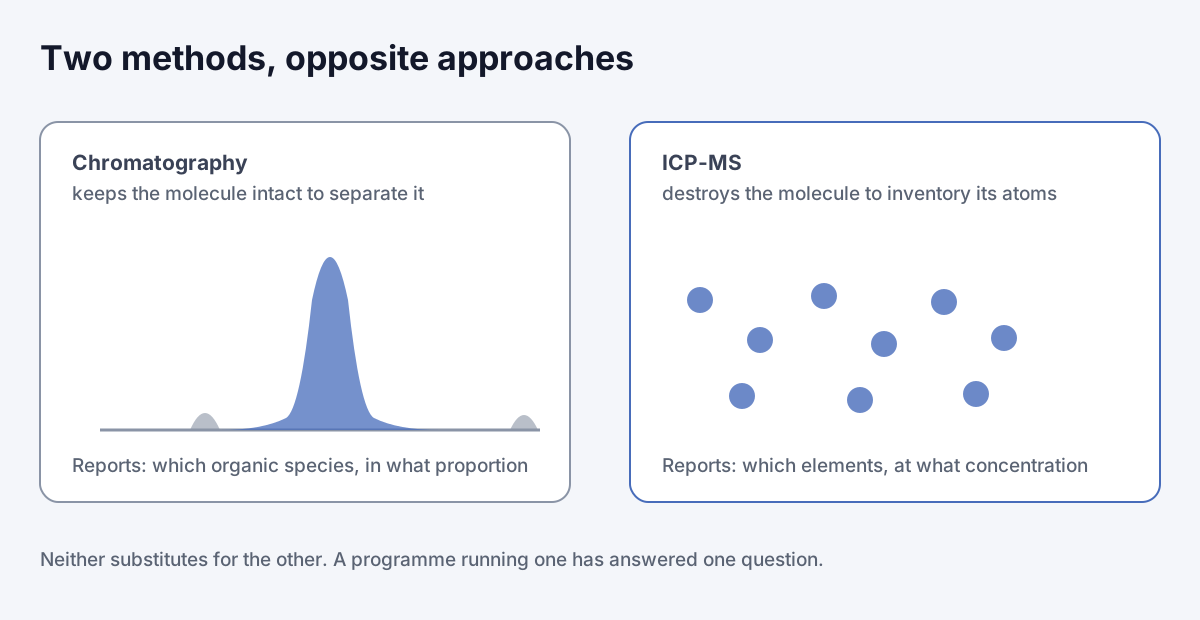
This is what makes the technique complementary rather than redundant. Chromatography preserves the molecule in order to separate it from its relatives. ICP-MS breaks the molecule apart in order to inventory its atoms. Neither can substitute for the other, and a testing programme that runs only one has answered only one kind of question. Certificates posted for Janera lots, including their ICP-MS results, are on our lab results page; where a certificate is not yet posted, the listing says so.
Where Elemental Contamination Comes From
Elemental impurities are not a sign of careless work by default. Several routes into a finished material are ordinary consequences of how chemistry is done, which is exactly why screening exists rather than trust.
Catalysts and reagents. Some peptide syntheses use metal reagents; palladium catalysts, for example, are used to remove certain protecting groups (Wilson et al., 2016). The drug regulatory framework lists residual catalysts added in synthesis as a recognized source of elemental impurities (International Council for Harmonisation, 2022), which is why their carry-through is assessed rather than assumed.
Processing equipment. Manufacturing equipment is a recognized source as well. The same framework treats the processes used to make a drug substance as considerably more aggressive, in their potential to leach elements from equipment, than drug-product processing, while noting that equipment selection, qualification and manufacturing controls ensure a low contribution (International Council for Harmonisation, 2022). A peptide is a drug substance of that kind; its standard route, Fmoc solid-phase synthesis, ends by cleaving the peptide from the resin with trifluoroacetic acid (Behrendt, White and Offer, 2016).
Raw materials and water. The framework lists the drug substance, water and excipients as potential sources of elemental impurities. By the same logic, the solvents, resins and building blocks used to make a peptide can bring in trace elements of their own.
Containers and closures. The container-closure system is a recognized source too, though leaching into solid forms is considered minimal. For liquid forms the probability of leaching is higher (International Council for Harmonisation, 2022), and a liquid is what a peptide becomes once reconstituted.
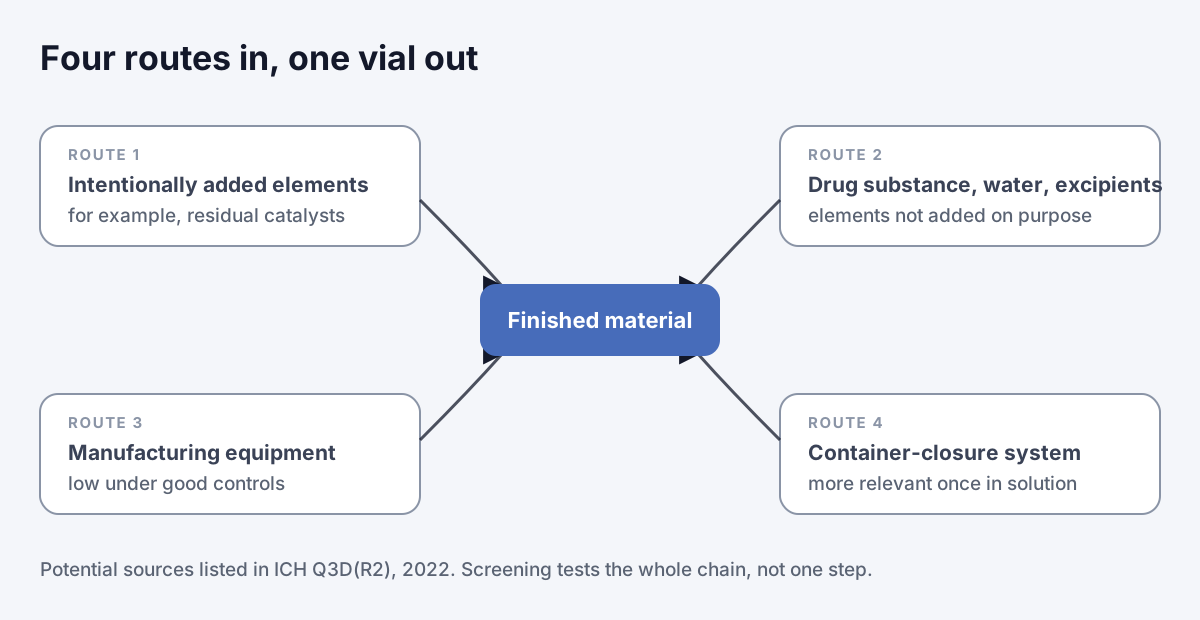
The practical consequence is that elemental screening is a test of the whole production chain rather than of the final synthetic step. It answers a question no other test on a certificate is asking.
The Regulatory Framework, and Where Research Materials Sit
Pharmaceutical manufacturing has a defined framework for this. FDA's 2018 implementation guidance states that it "provides recommendations regarding the control of elemental impurities of human drug products marketed in the United States consistent with implementation of International Council for Harmonisation (ICH) guidance for industry Q3D Elemental Impurities (ICH Q3D)" (U.S. Food and Drug Administration, 2018).
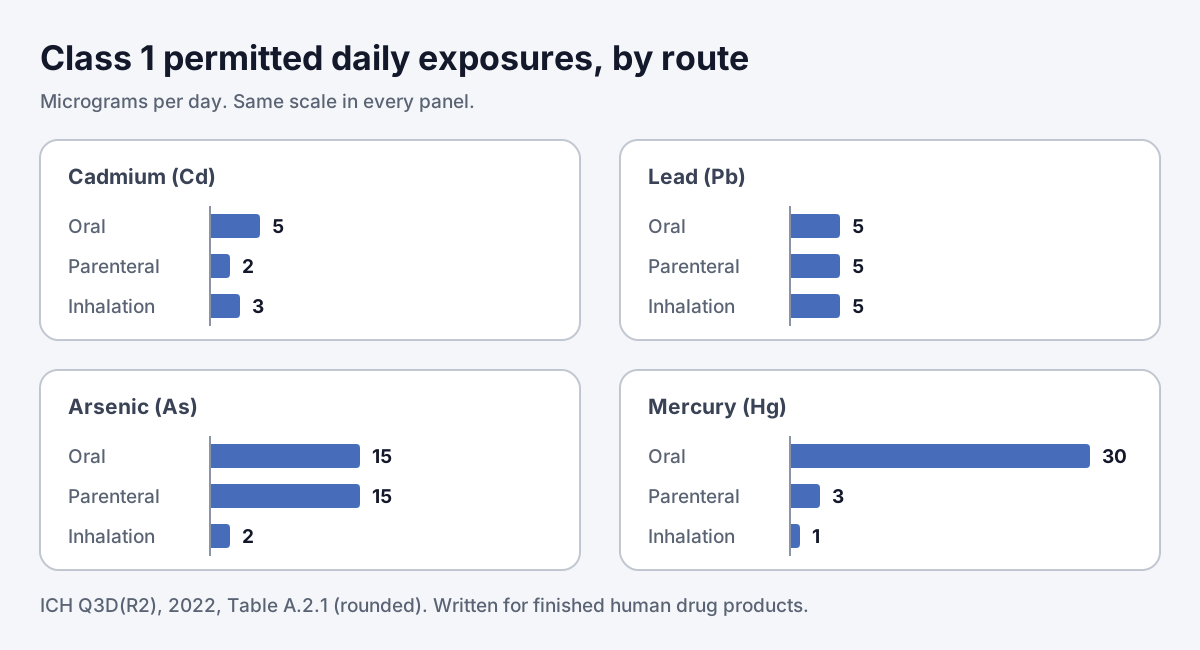
That framework classifies elements by toxicity and likelihood of occurrence, and sets a permitted daily exposure for each by route of administration. Class 1, the four elements Q3D says require evaluation in the risk assessment across all potential sources and routes of administration, is arsenic, cadmium, mercury and lead: human toxicants with limited or no use in pharmaceutical manufacture. For an oral drug product the permitted daily exposures are 5 µg/day of cadmium, 5 µg/day of lead, 15 µg/day of arsenic and 30 µg/day of mercury. The arsenic figures are based on inorganic arsenic and the mercury figures on elemental or inorganic mercury; the mercury limits do not apply to organic mercury. For some elements the route changes the figure sharply: mercury falls to 3 µg/day for a parenteral product and 1 µg/day for an inhaled one (International Council for Harmonisation, 2022).
The scope point matters more than the numbers here. Q3D's recommendations are written for new finished human drug products (International Council for Harmonisation, 2022), and they do not address reagents sold for laboratory research. In the United States, FDA adopted Q3D as non-binding guidance, alongside enforceable pharmacopeial limits and manufacturing regulations for drugs (U.S. Food and Drug Administration, 2018). Under FDA regulations, a product's intended use is judged by objective intent, which can be shown by labeling claims, advertising and the circumstances of distribution, not only by what the label says (21 CFR 201.128). Our guide to what Research Use Only means sets out that distinction in full.
So when a research supplier screens for elemental impurities, the case for it is experimental. Trace elemental impurities can catalyze the degradation of drug substances (International Council for Harmonisation, 2022), and they are biologically active: in one manufacturer's cell culture platform, a trace copper impurity in an iron source measurably improved cell performance and slightly altered the quality of the protein produced (Weiss et al., 2022). An uncharacterized metal in a cell culture experiment is an uncontrolled variable in someone's data.
Reading an Elemental Result
A screening result answers a narrow question precisely, and the value is in knowing which question that is.
It reports elements, and only elements. A clean elemental screen says nothing about peptide purity, identity, endotoxin, or sterility. Those are four other tests answering four other questions.
It describes the lot that was sampled. Elemental contamination varies with the specific inputs and equipment used for a given run, so a result carries across production runs no better than any other batch measurement does. This is why lot-level documentation matters, and each certificate on our lab results page carries a lot number.
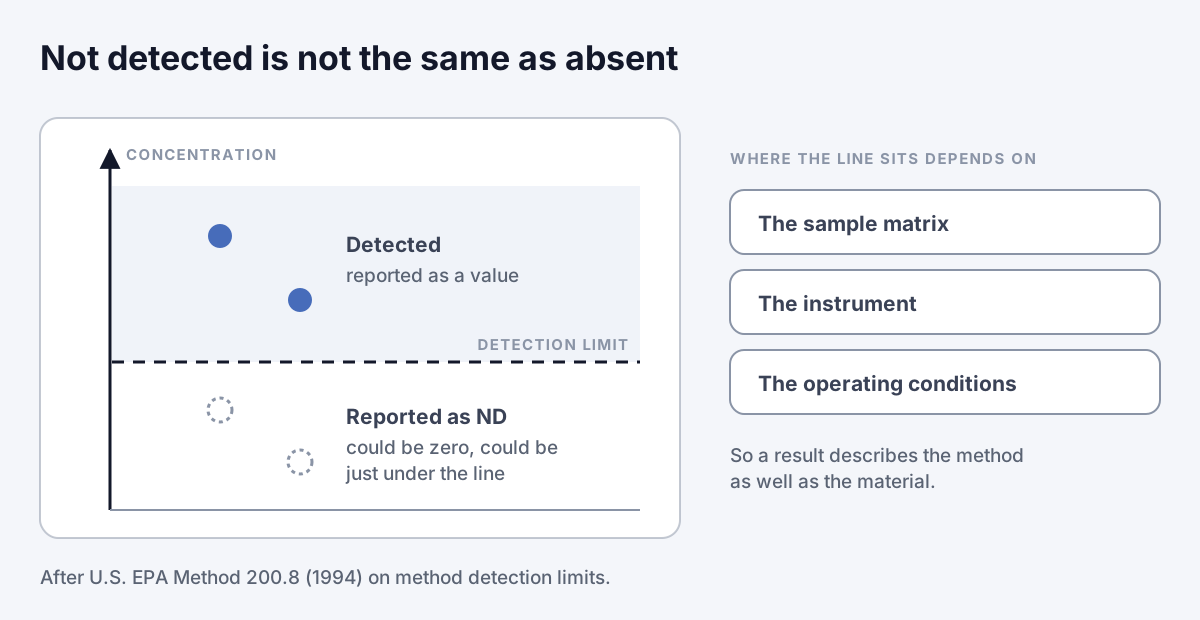
A limit is a threshold. Screening shows that the elements on the panel were not detected above the method's detection limits, which is different from showing they are absent. Those limits depend on the sample matrix, the instrument and the operating conditions (U.S. Environmental Protection Agency, 1994).
For anyone evaluating documentation, the useful question is whether an elemental result appears at all, and whether it is reported against the same lot number as the purity and assay results. A certificate carrying purity alone has left this entire category unexamined.
Frequently Asked Questions
Why does a peptide need heavy metal testing if it is 99 percent pure?
Because HPLC purity reports peptide-related impurities as a share of the total peak area detected, and inorganic content is measured by separate tests such as residue on ignition (McCarthy et al., 2023). The 99 percent figure and the elemental result describe different things, and neither implies the other.
What does ICP-MS actually detect?
Elements. The portion of sample analysed is atomized and ionized in an argon plasma, then the resulting ions are separated by mass-to-charge ratio and detected, with detection limits below one part per billion for many elements in the analysed solution.
Where do heavy metals in a research compound come from?
The drug regulatory framework recognizes four potential routes: residual catalysts and other intentionally added elements; the drug substance, water and excipients; manufacturing equipment; and the container-closure system, the last becoming more relevant once a peptide is in solution.
Are research-use materials required to meet elemental impurity limits?
ICH Q3D's limits, applied in the United States through FDA guidance, were written for new finished human drug products (International Council for Harmonisation, 2022; U.S. Food and Drug Administration, 2018). They do not address reagents sold for laboratory research, and Q3D itself is guidance rather than regulation. Under FDA regulations, intended use is judged by objective intent, including how a product is labeled and marketed, not only by a research use label (21 CFR 201.128). For research materials, the case for screening is experimental.
Can mass spectrometry of the peptide detect metals at the same time?
Not as a screen. Peptide mass spectrometry is an identity test: it confirms that the observed mass matches the peptide's expected mass (McCarthy et al., 2023). Elemental impurities are measured by ICP-MS, which ionizes elements in a high-temperature argon plasma regardless of their chemical form (Montoro Bustos, 2020).
Does a clean elemental screen mean the material is safe?
It means the elements on the panel fell below the limits applied. It says nothing about purity, identity, endotoxin or sterility, and these materials are not supplied for use in humans or animals under any result.
Key Takeaways
Peptide purity analysis is not built to see elemental contamination. HPLC purity reports peptide-related impurities by ultraviolet peak area, and inorganic content needs separate tests.
ICP-MS answers the question by breaking the analysed portion of the sample down to atoms. An argon plasma atomizes and ionizes it, and the resulting ions are separated by mass-to-charge ratio and detected.
Contamination can enter through four routes the drug regulatory framework recognizes: residual catalysts and other intentionally added elements, the drug substance, water and excipients, manufacturing equipment, and the container-closure system.
ICH Q3D, adopted in the United States as FDA guidance, is written for new finished human drug products and is guidance rather than regulation (International Council for Harmonisation, 2022; U.S. Food and Drug Administration, 2018). For research materials, the case for screening is experimental.
An elemental result is lot-specific and category-specific. It reports elements against one production run, and leaves purity, identity, endotoxin and sterility to the tests that measure them.
All Janera Science compounds are supplied strictly for in-vitro laboratory research use only. They are not intended for human or veterinary use, and are not intended to diagnose, treat, cure, or prevent any disease. The statements made on this website have not been evaluated by the U.S. Food and Drug Administration.
Review the Documentation
Available certificates for current compounds are listed on the lab results page. Each posted certificate reports HPLC purity and assay alongside an ICP-MS panel for arsenic, cadmium, lead and mercury, under a single lot number.