Restricted Access
This website is intended strictly for qualified research professionals. All products are sold for in-vitro laboratory research use only and are not intended for human or veterinary use.
Statements have not been evaluated by the U.S. Food and Drug Administration. Products are not intended to diagnose, treat, cure, or prevent any disease. Janera Science is not a 503A compounding pharmacy or 503B outsourcing facility.


Date
Category
Peptide synthesis impurities are the related molecules that occupy the small fraction of a research peptide vial that is not the target sequence. A certificate of analysis reporting 98 percent purity is also reporting that 2 percent of the material is something else.
That something else is not dust or random contamination. It is a predictable population of closely related molecules, each one generated by a specific chemical event during synthesis, cleavage, or handling.
Understanding which molecules those are, and why they form, changes how a researcher reads a purity number. It also explains why two vials with identical purity percentages can behave differently in an assay.
This content is provided for informational and educational purposes only and does not constitute medical, pharmaceutical, or legal advice. The products discussed are intended for laboratory research purposes only and are not for human or animal consumption. They are not intended to diagnose, treat, cure, or prevent any disease.

Why the Impurity Fraction Matters in a Research Context
In laboratory work, an impurity is a variable. A deletion sequence that differs from the target by one residue may still occupy the same binding site, compete for the same receptor in a cellular assay, or shift a concentration-response curve without ever appearing as a separate peak on a chromatogram.
This is a question of experimental reproducibility, not of anything else. Two batches of the same compound can carry different impurity profiles, and if those profiles are uncharacterized, the difference between experiments becomes untraceable.
The value of knowing the impurity classes is therefore practical. A researcher who can read a mass spectrum and recognize a plus 16 dalton satellite peak knows they are looking at an oxidation product, not an unknown contaminant.
An impurity profile that is understood is a variable that can be accounted for.
Where Peptide Synthesis Impurities Come From
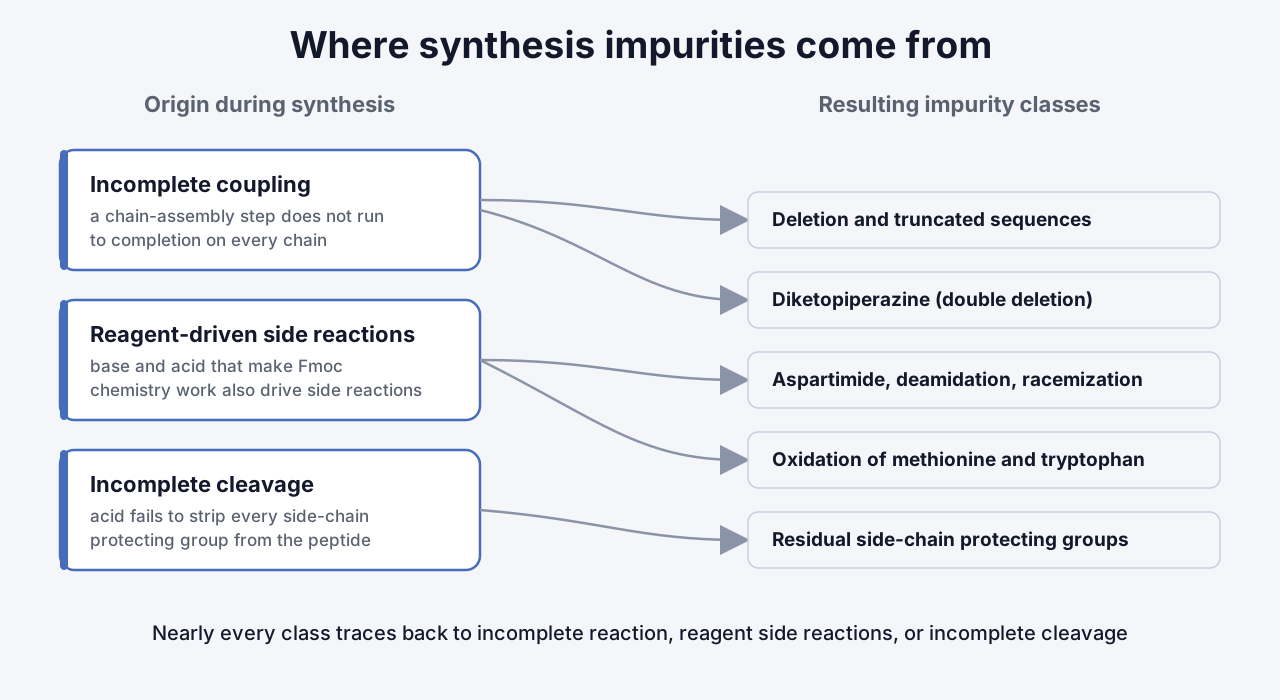
Nearly every impurity class traces back to one of three moments: an incomplete reaction during chain assembly, a side reaction promoted by the reagents used, or a chemical change that occurs after the peptide leaves the resin.
The arithmetic of incomplete coupling
Solid-phase peptide synthesis builds a chain one residue at a time. Every coupling step is a chemical reaction, and no chemical reaction runs to absolute completion.
The consequence compounds. If each of 30 coupling steps runs at 99 percent efficiency, the theoretical fraction of chains carrying the complete correct sequence is 0.99 raised to the power of 30, which is approximately 0.74. Roughly a quarter of the crude material is something other than the target, before any side reaction is considered.
This is why crude peptide always requires purification, and why longer sequences are harder to produce at high purity than shorter ones.
Aggregation and difficult sequences
Coupling efficiency is not uniform across a sequence. Growing chains on the resin can associate with one another through hydrogen bonding and hydrophobic contact, folding into structures that bury the reactive N-terminus.
Research measuring resin swelling across the synthesis of 87 unrelated peptides established that incomplete acylation is non-random and sequence-dependent, driven by aggregation of the resin-bound chains (International Journal of Peptide and Protein Research, 1993). Aggregation of the growing chain is described in the protocol literature as the main cause of failure in chemical peptide synthesis (Nature Protocols, 2007).
Sequences rich in contiguous hydrophobic residues, or in residues capable of forming inter-chain hydrogen bonds, are the usual offenders. These are the regions where deletions cluster.
Reagent-driven side reactions
The reagents that make Fmoc chemistry work also drive several of the most common impurity classes. Piperidine removes the temporary N-terminal protecting group at every step of chain assembly, and that same base catalyzes ring-closure reactions at aspartic acid residues.
Strong acid used at cleavage liberates the peptide from the resin and strips side-chain protecting groups, but incomplete cleavage leaves those groups attached. Each unremoved group produces a peptide of correct sequence and incorrect mass.
Truncation and Deletion Sequences
These two terms are frequently used interchangeably. They describe different molecules.
A deletion sequence is missing one or more internal residues but retains the rest of the chain. It arises when a coupling step fails at a given position and the chain continues to elongate normally afterward.
A truncated sequence is a shortened chain whose growth stopped entirely. It arises when the unreacted N-terminus is deliberately blocked, or when the chain is cleaved from its anchor prematurely.
Why capping produces truncations
Many synthesis protocols include a capping step, typically acetylation with acetic anhydride, applied after each coupling. Any chain that failed to couple has its free amine permanently blocked.
This is a deliberate trade. Capping converts a would-be deletion sequence, which differs from the target by a single residue and is very difficult to separate, into a much shorter acetylated fragment that resolves cleanly during purification.
Diketopiperazine formation
At the dipeptide stage, before the chain has grown, the freshly deprotected N-terminal amine can attack the ester bond linking the peptide to the resin. The result is a stable six-membered ring and the loss of the first two residues from the support.
The reaction is strongly sequence-dependent. It proceeds most readily when proline or glycine occupies position one or two, and classic work on a valine-proline resin recorded loss of up to 70 percent of the dipeptide during a single coupling (ACS Omega, 2022).
The same mechanism can operate further along a chain, producing an impurity missing two adjacent residues rather than one.
Impurity class | Origin | Mass relative to target |
|---|---|---|
Deletion sequence | Incomplete coupling at one position | Lower by one residue mass (Gly 57.02 Da, Ala 71.04 Da) |
Truncated sequence | Capping of a failed chain, or premature cleavage | Substantially lower, often plus 42.01 Da acetyl on the fragment |
Double deletion | Diketopiperazine ring closure mid-chain | Lower by two adjacent residue masses |
Incomplete side-chain deprotection | Insufficient acid cleavage | Higher: tBu approximately plus 56 Da, Trt approximately plus 242 Da, Pbf approximately plus 252 Da |
Insertion sequence | Double coupling at one position | Higher by one residue mass |
Scrambled disulfide | Non-native pairing during oxidative folding | Identical to target |

Oxidation, Deamidation, and Racemization
Deletions and truncations are errors of assembly. The next group are errors of chemistry, and they can occur during synthesis, during workup, during freeze-drying, or later during storage.
Oxidation
Amino acid side chains differ in their vulnerability to oxidation. Work on a model peptide using several oxidant systems established the ordering of susceptibility as cysteine, then methionine, then tryptophan, then histidine, then tyrosine (Journal of Pharmaceutical Sciences, 2009).
Methionine is the residue most often observed in practice. Its sulfur atom accepts a single oxygen to form methionine sulfoxide, adding 15.995 daltons, and can accept a second to form the sulfone at plus 32.
Tryptophan oxidation is chemically messier. Rather than a single clean product, the indole ring generates a family of species including N-formylkynurenine and kynurenine, which is why tryptophan-containing sequences often show several minor satellite peaks rather than one.
Deamidation
Asparagine and glutamine carry amide side chains that can hydrolyze to the corresponding acid. The reaction does not proceed by simple hydrolysis in most cases. The backbone nitrogen of the following residue attacks the side-chain carbonyl, forming a cyclic succinimide that then opens.
Because the ring is asymmetric, opening produces a mixture. Both aspartate and isoaspartate result, with the isoaspartyl form generally dominating, and the succinimide can racemize before it opens (Electrophoresis, 2010).
The mass change is small. Converting an amide to an acid replaces NH2 with OH, a shift of plus 0.984 daltons, which is why deamidation is often described as a plus 1 impurity and why high-resolution instruments are needed to see it cleanly.
Aspartimide formation
Aspartic acid runs the same cyclization chemistry, and under Fmoc conditions it runs it repeatedly. The base used at every deprotection step deprotonates the backbone amide adjacent to the aspartic acid residue, which then attacks the protected side-chain carbonyl to close a five-membered imide ring (ChemBioChem, 2025).
The cyclic intermediate is a branch point. It can hydrolyze to a mixture of alpha and beta peptides, epimerize to the D form, or be attacked by piperidine itself to form a piperidide adduct at plus 67 daltons.
Susceptibility is sequence-driven. Aspartic acid followed by glycine is the classic problem motif, with serine, threonine, asparagine, and alanine also elevating the rate (Journal of Peptide Science, 2016).
Racemization
Every residue in a synthetic peptide should be the L enantiomer. Activation of the carboxyl group before coupling acidifies the alpha proton, and if a base removes it, the resulting planar intermediate can be reprotonated from either face.
Cysteine and histidine are the residues most prone to this, with aspartic acid vulnerable through the aspartimide route. A systematic study of cysteine incorporation found D to L ratios as high as 33 percent under some widely used coupling protocols, reducible to under 1 percent per step with optimized conditions (Journal of Organic Chemistry, 1997). Temperature contributes as well, and lowering coupling temperature from 80 to 50 degrees Celsius has been shown to limit racemization of histidine and cysteine (Journal of Peptide Science, 2007).
Racemization is the hardest impurity class to detect, for a reason worth stating plainly. A D-containing diastereomer has exactly the same molecular formula and exactly the same mass as the target. Mass spectrometry alone cannot see it.

Disulfide Errors: Scrambled and Mismatched Bonds
Racemization is not the only impurity class that shares its mass with the target. Peptides carrying more than one cysteine face a second same-mass problem, and it arises at the folding step rather than during chain assembly.
Once the chain is built and cleaved, cysteines pair with one another to form disulfide bonds. The correct molecule has one specific pairing pattern. Any other pattern is an impurity built from exactly the same atoms.
Why the isomer count grows quickly
The number of possible pairings rises sharply with each added bond. A peptide with six cysteine residues forming three disulfide bonds can adopt 15 distinct isomers, and one with eight cysteines forming four bonds can theoretically form 105 (Chemical Science, 2025). Only one of those arrangements is the intended structure.
Inefficient oxidative folding raises the chance that some fraction of the chains locks into a non-native, scrambled pattern before the correct pairing can form.
Detecting a same-mass structural difference
A scrambled disulfide has the same molecular formula and the same mass as the correctly folded peptide, so mass spectrometry has nothing to measure. There is no mass difference to find.
Resolving these isomers requires orthogonal methods that respond to shape and connectivity rather than to mass, such as chromatographic separation paired with targeted fragmentation. Alongside racemization, this is the clearest case where a single analytical technique falls short of characterizing what is actually in a vial.
How HPLC and Mass Spectrometry Identify Each Class
Neither technique is sufficient alone. The division of labour is the entire reason thorough purity testing uses both, and reports them as separate results.
Reversed-phase HPLC separates by hydrophobicity and quantifies by peak area. Oxidized species are more polar than the parent peptide and typically elute earlier, which makes oxidation one of the easier classes to spot chromatographically.
Mass spectrometry identifies by mass-to-charge ratio and cannot quantify reliably on its own, since ionization efficiency varies between species. What it does supply is structural identity, and tandem fragmentation can localize a modification to a specific residue.
Impurity class | Visible by HPLC | Visible by MS | Notes |
|---|---|---|---|
Deletion sequence | Usually, as a resolved peak | Yes, clear mass loss | Single-residue deletions may co-elute |
Truncated sequence | Yes, well resolved | Yes | Large retention shift makes these easy |
Oxidation | Yes, earlier eluting | Yes, plus 16 or plus 32 Da | Among the most reliably detected |
Deamidation | Sometimes, small shift | Yes, plus 0.984 Da | Needs high-resolution MS to separate from isotope peaks |
Aspartimide and adducts | Variable | Yes, minus 18 or plus 67 Da | Alpha and beta peptides can co-elute exactly |
Racemization | Only with chiral or optimized methods | No, mass is identical | Requires chiral analysis or amino acid analysis after hydrolysis |
Scrambled disulfide | Sometimes, with methods developed for the pair | No, mass is identical | Requires orthogonal methods sensitive to connectivity |
The gaps in that table are the honest limitation of routine analysis. Beta-aspartyl peptides and epimerized alpha-aspartyl peptides frequently share both retention time and mass with the target, which makes them among the most difficult impurities to detect by standard methods.
What This Means for the Purity Number on a Certificate of Analysis
A purity percentage is an HPLC area measurement. It reports the proportion of the integrated chromatogram attributable to the main peak under one specific set of chromatographic conditions.
That definition carries three consequences worth internalizing when reading a certificate of analysis.
Anything co-eluting is counted as target. If an impurity shares the retention time of the main peak, its area is folded into the purity figure. The number is a ceiling, not a guarantee.
The number describes proportion, not quantity. HPLC purity does not tell a researcher how much peptide is in the vial. Counter-ions, residual water, and residual solvent occupy mass without appearing in the chromatogram, which is why net peptide content is reported separately.
Identification is a separate question from quantification. A supplier can report 99 percent purity without ever identifying what the remaining 1 percent is. Identity documentation, including sequence, molecular formula, and the CAS number where one exists, answers a different question than the purity figure does.
The benchmark for what characterization can look like
Pharmaceutical manufacturing frameworks show how finely a peptide impurity profile can be resolved when the analytical effort is maximal. United States regulatory guidance covering certain highly purified synthetic peptide drug products sets an identification threshold of 0.10 percent, meaning each peptide-related impurity above that level must be structurally characterized rather than merely counted (U.S. Food and Drug Administration, 2021).
That framework governs pharmaceutical manufacturing and does not apply to materials supplied for laboratory use. Janera Science supplies all materials strictly under a research use only designation. The threshold is cited here only as a reference point for the resolution modern analytical chemistry is capable of reaching.
For a researcher evaluating documentation, the useful question follows from that. Not simply how high the purity number is, but which method produced it, whether a mass spectrum accompanies it, and whether the reported batch documentation shows both an identity confirmation and a purity determination rather than one standing in for the other.

Frequently Asked Questions
What causes impurities in synthetic peptides?
Most impurities arise during chain assembly, when a coupling or deprotection step fails to run to completion, or from side reactions driven by the reagents used in synthesis and cleavage. A smaller group forms afterward through oxidation and deamidation during workup, lyophilization, or storage.
What is the difference between a truncated sequence and a deletion sequence?
A deletion sequence is missing one or more internal residues but retains the full length of the rest of the chain, arising from a failed coupling. A truncated sequence is a shortened chain whose elongation stopped, usually because the failed chain was deliberately capped or because it was cleaved from the resin early.
Why does a 98 percent pure peptide still contain impurities?
No chemical reaction runs to completion, and a peptide chain requires one coupling and one deprotection reaction per residue. Across 30 or more steps, even 99 percent efficiency per step leaves roughly a quarter of the crude material as something other than the target, and purification reduces but never eliminates that fraction.
What does a plus 16 dalton peak on a mass spectrum indicate?
A peak 16 daltons above the target mass generally indicates the addition of a single oxygen atom, most commonly methionine oxidized to methionine sulfoxide. A plus 32 peak indicates a second oxygen, which for methionine corresponds to the sulfone.
What is a scrambled disulfide, and why is it hard to detect?
A scrambled disulfide is a peptide whose cysteines have paired in a non-native pattern during oxidative folding. It contains exactly the same atoms as the correct molecule and therefore has an identical mass, so mass spectrometry cannot distinguish it and detection depends on methods that respond to shape and connectivity.
Can HPLC detect a racemized peptide?
Standard reversed-phase HPLC often cannot, because a diastereomer containing a D residue may co-elute with the target under routine conditions. Detection generally requires chiral chromatography, an optimized gradient developed specifically to resolve the pair, or amino acid analysis following hydrolysis.
Does a higher purity percentage always mean a better characterized peptide?
No. A purity percentage reports the proportion of chromatographic area attributable to the main peak, and says nothing about what the remaining material is or whether anything co-elutes with the target. Documentation that reports purity alongside a mass spectrum and a net peptide content figure conveys substantially more than a single number.
Key Takeaways
Peptide synthesis impurities are structured, not random. Each class traces to a specific chemical event, and the class can usually be inferred from a mass difference and a retention shift.
Coupling efficiency compounds. Thirty steps at 99 percent efficiency leaves approximately 74 percent of chains as correct full-length sequence, which is why purification is mandatory and why long sequences are harder to produce cleanly.
Aggregation of resin-bound chains is the dominant cause of synthesis failure, and it is sequence-dependent rather than random (International Journal of Peptide and Protein Research, 1993).
Two impurity classes share the target's exact mass and are invisible to mass spectrometry: racemized diastereomers, and scrambled disulfides in peptides carrying more than one cysteine. Both require analytical methods that respond to structure rather than mass.
A purity percentage is an area measurement under one set of conditions. It is a ceiling rather than a guarantee, and it is most useful when read alongside an identity confirmation and a net peptide content figure.
This content is provided for informational and educational purposes only and does not constitute medical, pharmaceutical, or legal advice. The products discussed are intended for laboratory research purposes only and are not for human or animal consumption. They are not intended to diagnose, treat, cure, or prevent any disease.
Verify Every Batch
Janera Science publishes third-party Certificates of Analysis for its research peptides. To review HPLC purity, heavy metal, endotoxin and sterility results for current lots, visit our lab results page. For the regulatory context behind how these materials are supplied, see our overview of what Research Use Only means.