Restricted Access
This website is intended strictly for qualified research professionals. All products are sold for in-vitro laboratory research use only and are not intended for human or veterinary use.
Statements have not been evaluated by the U.S. Food and Drug Administration. Products are not intended to diagnose, treat, cure, or prevent any disease. Janera Science is not a 503A compounding pharmacy or 503B outsourcing facility.


Date
Category
Lyophilized peptides are research compounds that have had their water removed by freeze-drying, leaving a dry solid in a sealed vial. The process converts a peptide dissolved in water into a stable powder for laboratory storage, and it is the reason research peptides arrive as a small white cake or fluffy solid at the bottom of a sealed vial rather than as a ready-made solution. The process is not a packaging preference. It is a deliberate chemical strategy for removing the single most destabilizing component a peptide can be exposed to: water.
This article explains the chemistry of freeze-drying from first principles. It covers sublimation under vacuum, the role of cryoprotectants and lyoprotectants, what changes structurally when a peptide is converted from solution to a lyophilized solid, why residual moisture matters for long-term stability, and what all of this means for the powder a laboratory receives.
This content is provided for informational and educational purposes only and does not constitute medical, pharmaceutical, or legal advice. The products discussed are intended for laboratory research purposes only and are not for human or animal consumption. They are not intended to diagnose, treat, cure, or prevent any disease.
What Is Peptide Lyophilization?
Peptide lyophilization, also called freeze-drying, removes water from a frozen sample through two physical mechanisms: sublimation and desorption. It can be viewed as a three-step sequence consisting of freezing, primary drying, and secondary drying (Biotechnology and Applied Biochemistry, 2004).
The defining feature of the process is that water never passes through a liquid phase on its way out of the vial. Instead, the sample is frozen solid, and the ice is then converted directly to vapour under low pressure. This direct solid-to-vapour transition is sublimation, and it is what allows a delicate molecule to be dried without the heat and surface-tension stresses that ordinary evaporation would impose (Pharmaceutics, 2024).

The end product is a dry solid, often described as a cake, that can be stored for extended periods. Solid-state storage is the preferred format for sensitive molecules precisely because it reduces the physical and chemical degradation associated with liquid formulations (International Journal of Biological Macromolecules, 2020).
Understanding why that matters requires looking at what water actually does to a peptide held in solution.
Why Water Destabilizes Peptides in Solution
Peptides are short chains of amino acids. Unlike large proteins, they generally lack the tertiary and quaternary folding that can shield reactive groups, so the side chains of their amino acid residues are predominantly exposed to the surrounding solvent (Pharmaceutics, 2023). In an aqueous environment, that exposure leaves the molecule open to several water-driven degradation pathways.
The most direct is hydrolysis, in which water participates in cleaving the peptide bonds that hold the chain together. Hydrolysis is catalyzed by acids and bases and depends strongly on pH (Pharmaceutics, 2023). A second pathway is deamidation, in which the amide side chains of asparagine and glutamine residues react in solution and convert to acidic groups, altering the molecule's charge and structure. A third is oxidation, which targets residues such as methionine, cysteine, and tryptophan.
Each of these reactions requires, or is accelerated by, the presence of water. Remove the water and the primary medium for these reactions is removed with it. This is the core logic of lyophilization: it does not add a protective ingredient so much as eliminate the reactant that drives the most common forms of decomposition.
This is also why the way a peptide is handled, documented, and verified matters. The purity figure on a Certificate of Analysis reflects the molecule at the point of testing, and preserving that state through storage is the job lyophilization is designed to do.
The Three Stages of the Freeze-Drying Cycle
A freeze-drying cycle is engineered as three distinct stages, each removing water in a different way and each carrying its own technical constraints.

Stage 1: Freezing
The peptide solution is cooled until the water in it forms ice. This is more consequential than it sounds. As ice crystals form, the dissolved peptide and any added excipients become concentrated in the small fraction of liquid that has not yet frozen, a region known as the freeze-concentrate. The structure of the ice and the behaviour of this concentrated phase set the conditions for everything that follows.
Stage 2: Primary Drying (Sublimation)
With the sample frozen, the chamber pressure is lowered and gentle heat is applied so that the ice sublimes directly to vapour, which is then captured on a cold condenser. Primary drying removes the bulk of the water, specifically the unbound ice.
The critical control parameter here is temperature. During primary drying, the product temperature is held below the glass transition temperature of the freeze-concentrate, written as Tg prime, so that the matrix stays in a rigid glassy state (Pharmaceutics, 2024). Holding below this threshold prevents the cake from collapsing and preserves the structural integrity of the dried matrix. If the product warms above Tg prime, the freeze-concentrate softens into a rubbery state, and the cake can collapse.
Stage 3: Secondary Drying (Desorption)
Sublimation alone does not remove all the water. A fraction remains bound to the molecule and the matrix. Secondary drying removes this bound water through desorption, usually by raising the temperature modestly while keeping the matrix stable (Pharmaceutics, 2024). This final step brings the cake down to its target residual moisture, the figure that governs how stable the powder will be in long-term storage.
Cryoprotectants and Lyoprotectants: How Excipients Protect the Molecule
Freezing and drying are themselves stresses. The same process that protects a peptide from long-term degradation can, if uncontrolled, damage it during manufacture. This is why formulations often include protective additives, and why two different categories of protectant exist for two different stages.
Cryoprotectants protect the molecule from denaturation during the early freezing stage. Lyoprotectants are needed to prevent inactivation during the drying stage itself (Biotechnology and Applied Biochemistry, 2004). The protectants used in freeze-dried formulations are commonly grouped into sugars, polyols, surfactants, and amino acids (Pharmaceutics, 2024).

How these additives work is one of the more interesting questions in the field, and the literature describes two complementary mechanisms. The first is vitrification, in which sugars immobilize the molecule within a rigid glassy matrix of very low molecular mobility, slowing the reactions that would otherwise degrade it. The second is the water replacement hypothesis, in which sugars hydrogen-bond to the molecule in place of the water that has been removed, helping to maintain the interactions that water previously supported (Molecular Pharmaceutics, 2025).
The practical effect is well documented. In-process degradation is typically minimized by rapid freezing and by drying below the relevant glass transition temperature, with stabilizing sugars and polyols added to reduce decomposition during both processing and storage (Journal of Pharmaceutical Sciences, 2005). In one illustrative case, conformational changes and aggregation observed during freeze-drying were prevented by using sucrose as a lyoprotectant (Biotechnology and Applied Biochemistry, 2004).
The same analytical techniques used to verify a finished peptide, including HPLC and mass spectrometry, are the tools researchers use to confirm that a molecule survived the freeze-drying cycle intact.
Residual Moisture and Long-Term Stability
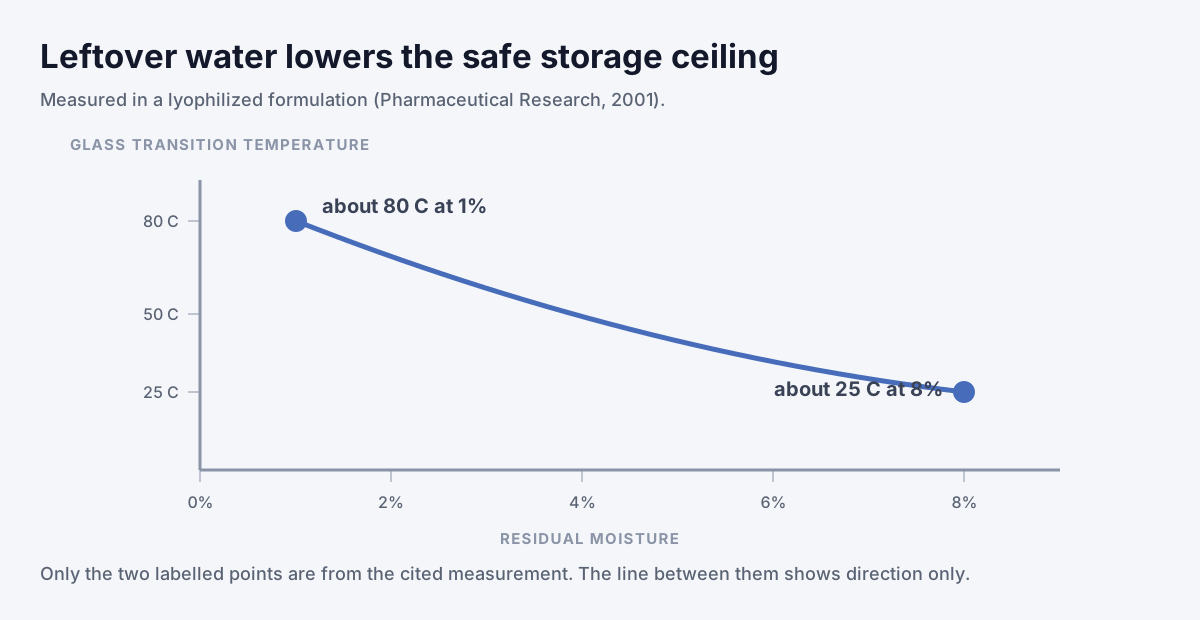
The amount of water left in the cake after drying, the residual moisture, is one of the most important determinants of how a lyophilized peptide will hold up over time. Water acts as a plasticizer: the more of it that remains, the more mobile the glassy matrix becomes, and the lower its glass transition temperature falls.
The relationship is measurable. In a lyophilized monoclonal antibody formulation, the glass transition temperature varied from roughly 80 degrees C at one percent residual moisture down to about 25 degrees C at eight percent moisture, and cakes with higher moisture showed higher aggregation rates when stored above their glass transition temperature (Pharmaceutical Research, 2001). In other words, leftover water both increases reactivity and lowers the temperature below which the dried matrix stays rigid and glassy. For this reason, formulations are often dried to an optimum residual moisture, frequently below one percent (Journal of Pharmaceutical Sciences, 2005).
There is a nuance worth noting. The intuition that drier is always better does not hold without limit. Research on lyophilized formulations indicates that products can be over-dried, which can itself reduce stability, so extremely low water concentrations are generally avoided (Molecular Pharmaceutics, 2025). The objective is an optimum, not a minimum.
This is the deeper reason a lyophilized peptide is sensitive to its sealed environment. The vial is closed at a controlled low moisture content, and any later ingress of atmospheric water moves the powder away from the condition in which it was designed to be stable.
What Lyophilization Means for the Powder You Receive
Freeze-drying is a powerful stabilization method, but it is not an entirely passive one. The literature is explicit that drying can produce measurable changes in molecular conformation. Studied by Fourier-transform infrared spectroscopy, drying tends to produce a decrease in alpha-helix and random-coil content and an increase in beta-sheet structure (Biotechnology and Applied Biochemistry, 2004). A well-designed formulation, with appropriate lyoprotectants and a controlled cycle, is what keeps these changes within acceptable limits and reversible upon return to solution.
This is also why a freeze-dried peptide is not indifferent to moisture once it is dry. In the presence of water, freeze-dried material can undergo reactions such as disulphide interchange that lead to loss of activity (Biotechnology and Applied Biochemistry, 2004). The sealed, low-moisture vial is part of the stability design, not merely its container.
Every peptide that reaches this stage has already moved through synthesis, purification, and verification. The chemistry of how the chain is assembled is covered in our guide to solid-phase peptide synthesis, and the molecular detail of a specific compound, such as BPC-157, illustrates how sequence and structure are documented before a peptide is ever freeze-dried.
Reading the Cake: What the Powder Itself Tells You
The physical appearance of a lyophilized cake is a readable record of the cycle that produced it. Every property described above, the freezing behaviour, the glass transition of the freeze-concentrate, the residual moisture target, leaves a visible trace in the solid at the bottom of the vial.
None of this replaces analytical documentation. It is the one quality signal available before a certificate is opened, and it costs a glance.

A firm, uniform cake
The intended result is a solid that holds the shape of the frozen volume, occupies roughly the space the solution occupied, and has an even, matte, slightly porous appearance. That porosity is the physical evidence of sublimation: each void is where an ice crystal stood before it left as vapour.
A cake like this indicates the product temperature stayed below the glass transition of the freeze-concentrate throughout primary drying, so the matrix remained rigid while the ice departed.
A collapsed or shrunken cake
A cake that has slumped, pulled away from the vial wall, or fused into a dense glassy layer indicates the matrix softened during drying. As set out above, warming above Tg prime moves the freeze-concentrate from a rigid glassy state into a rubbery one, and the structure loses its ability to hold the void space open.
The consequence is more than cosmetic. A collapsed matrix dries less efficiently, which tends to leave higher residual moisture, and higher residual moisture lowers the glass transition temperature further and raises degradation rates. The visual defect and the stability risk share a cause.
A thin film or a loose powder
Material that appears as a thin film on the vial base, or as a free-flowing powder rather than a formed cake, usually reflects a very low solid content or a formulation without a bulking agent. It is common and not a defect in itself.
What it does mean is that the visual check carries less information for that vial, so the certificate does the whole job.
Discolouration
A lyophilized peptide is normally white to off-white. Yellowing or browning is worth querying, because it is more often associated with degradation than with the drying cycle.
What the cake cannot tell you
A textbook cake is not evidence of purity, identity, or elemental or biological cleanliness. Every degradation route in this article proceeds without changing how the solid looks, and the same is true of the impurity classes formed during synthesis, covered in our guide to synthesis impurities.
Appearance is a first filter. The measurement is on the certificate, and each posted certificate is listed against its lot on our lab results page.
Frequently Asked Questions
What does lyophilized mean for a peptide?
Lyophilized means freeze-dried. A lyophilized peptide has had its water removed by freezing the solution and then subliming the ice away under vacuum, leaving a dry solid. The format is used because removing water removes the medium that drives hydrolysis, deamidation, and oxidation (Pharmaceutics, 2023).
Why are research peptides supplied as a powder instead of a solution?
Peptides in solution are exposed to water-driven degradation, and solid-state storage reduces the physical and chemical degradation associated with liquid formulations (International Journal of Biological Macromolecules, 2020). Supplying the peptide as a dry powder extends the window over which it remains stable for laboratory use.
What is sublimation in freeze-drying?
Sublimation is the direct conversion of solid ice to water vapour without passing through a liquid phase. In lyophilization it occurs during primary drying, when chamber pressure is lowered so that frozen water leaves the sample as vapour (Pharmaceutics, 2024).
What is the difference between a cryoprotectant and a lyoprotectant?
A cryoprotectant protects the molecule from denaturation during the freezing stage, while a lyoprotectant prevents inactivation during the drying stage. Some excipients, such as certain sugars, can serve both functions (Biotechnology and Applied Biochemistry, 2004).
Why does residual moisture matter in a lyophilized peptide?
Residual water plasticizes the dried matrix and lowers its glass transition temperature, which increases molecular mobility and the rate of degradation reactions. Studies of lyophilized formulations show the glass transition temperature falling substantially as moisture rises (Pharmaceutical Research, 2001).
Can a peptide be too dry?
Research indicates that lyophilized products can be over-dried, which can reduce stability rather than improve it. The aim of the process is an optimum residual moisture content, not the lowest possible value (Molecular Pharmaceutics, 2025).
Key Takeaways
Lyophilization removes the reactant, not just the volume. Freeze-drying eliminates water, which is the medium that drives hydrolysis, deamidation, and oxidation in peptides held in solution.
The cycle has three engineered stages. Freezing, primary drying by sublimation, and secondary drying by desorption each remove water differently and each carry distinct technical constraints.
Temperature control protects structure. Primary drying is held below the glass transition temperature of the freeze-concentrate to keep the matrix glassy and prevent cake collapse.
Excipients work by vitrification and water replacement. Cryoprotectants guard the freezing stage and lyoprotectants guard the drying stage, immobilizing the molecule in a glassy matrix and substituting for lost hydrogen bonds.
Residual moisture sets the stability ceiling. Leftover water lowers the glass transition temperature and accelerates degradation, which is why the sealed, low-moisture vial is part of the stability design.
Verify Every Batch
Janera Science publishes third-party Certificates of Analysis for its research peptides. To review HPLC purity, heavy metal, endotoxin and sterility results for current lots, visit our lab results page. For the regulatory context behind how these materials are supplied, see our overview of what Research Use Only means.