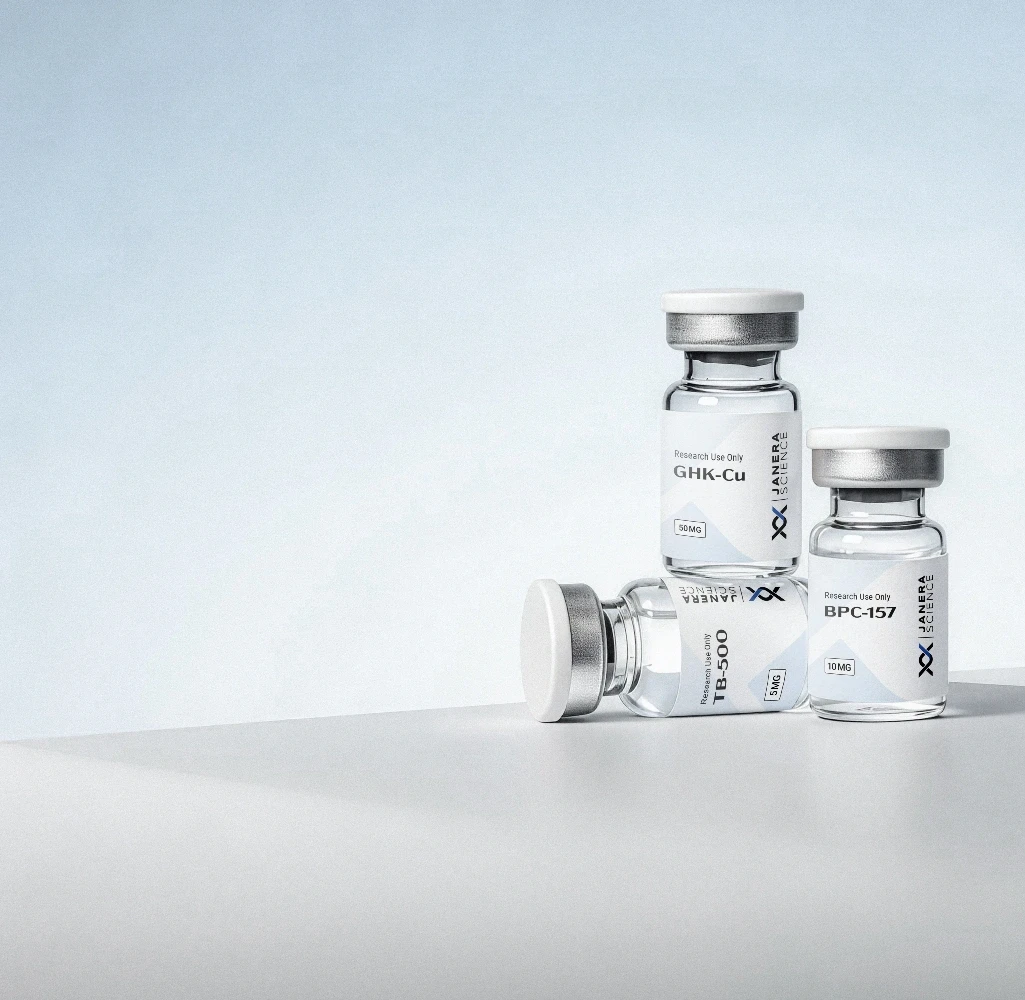

All Janera Science compounds are supplied strictly for in-vitro laboratory research use only. They are not for human or veterinary use and have not been evaluated by the FDA.
How to Use the Calculator
Paste a sequence, set the two termini, and every value updates as you type. The calculator reads the 20 standard amino acids and flags any character it does not recognise.
Enter the sequence. One-letter code (GEPPPGKPADDAGLV) and three-letter code (Gly-Glu-Pro-Pro-Pro) both work. A leading "Ac-" or a trailing "-NH2" is read as an acetylated N-terminus or an amidated C-terminus.
Set the N-terminus. Choose a free amine or an acetyl cap.
Set the C-terminus. Choose a free acid or an amide.
Choose a pH for the net charge. The default is 7.0.
To start from a known compound, pick it from the list. Each preset loads the sequence and termini of that compound, and every preset was checked against its PubChem record.
What Each Value Means
Each result describes a different property of the same sequence, and each one is calculated from the residue composition and the termini.
Result | What it tells you |
|---|---|
Average molecular weight | The mass of one mole of the molecule, using the standard atomic weight of each element, which reflects natural isotope abundance. |
Monoisotopic mass | The mass calculated from the most abundant isotope of each element (carbon-12, hydrogen-1, nitrogen-14, oxygen-16, sulphur-32). For peptides made of these five elements it is lower than the average weight. |
Molecular formula | The count of carbon, hydrogen, nitrogen, oxygen and sulphur atoms in the whole molecule. |
Net charge | The estimated overall charge at the chosen pH, from the ionisable side chains and termini. |
Isoelectric point (pI) | The pH at which the estimated net charge is zero. |
Hydropathy (GRAVY) | The grand average of hydropathy: the mean Kyte-Doolittle score across all residues. Positive values lean hydrophobic, negative values lean hydrophilic. |
How the masses are calculated
The calculator adds up the atoms in each residue, then adds one water molecule for the free termini of a linear chain. An acetyl cap adds C2H2O, and a C-terminal amide replaces the terminal OH with NH2.
Average weights use the abridged standard atomic weights published by the Commission on Isotopic Abundances and Atomic Weights: carbon 12.011, hydrogen 1.008, nitrogen 14.007, oxygen 15.999 and sulphur 32.06 (CIAAW).
How charge and pI are estimated
Net charge comes from the Henderson-Hasselbalch relationship applied to each ionisable group, using the default pKa values of the EMBOSS iep program: N-terminus 8.6, C-terminus 3.6, Cys 8.5, Asp 3.9, Glu 4.1, His 6.5, Lys 10.8, Arg 12.5 and Tyr 10.1 (EMBOSS). This calculator treats an acetylated N-terminus and an amidated C-terminus as uncharged.
Published pKa sets differ slightly, so a pI from another tool can differ. The value is an estimate for a peptide in water and does not account for neighbouring residues or folding.
How hydropathy is scored
Each residue is assigned its Kyte-Doolittle hydropathy value (Journal of Molecular Biology, 1982), and the GRAVY score is the sum of those values divided by the number of residues (ExPASy ProtParam).
What the Calculator Does Not Include
The results describe a linear peptide built from the 20 standard amino acids, with no other modifications. Several common features change the real molecule and are left out.
D-amino acids have the same mass and formula as their L forms, so a sequence such as CJC-1295 (no DAC), which contains D-alanine, calculates correctly.
Disulfide bonds remove two hydrogen atoms for each bond formed.
Cyclization, such as the lactam ring in Melanotan II, removes a molecule of water for each ring.
Salts and counter-ions, such as acetate or trifluoroacetate, are part of the weighed powder and do not appear in the peptide's own formula. Our guide to counter-ions in research peptides explains the difference.
Metal complexes, such as the copper in GHK-Cu, are not included. The GHK preset gives the peptide alone.
Non-standard residues, such as norleucine, are not recognised.
Identity Data on Documentation
Molecular formula, molecular weight and CAS number together identify a compound on paper. Our guide to CAS numbers explains how to check one.
Janera Science posts lot-specific certificates on our lab results page, and each one reports HPLC purity and assay, heavy metal screening, endotoxin and sterility. Our guide to reading a COA walks through each field, and our How Janera Tests page sets out what each test covers.
Frequently Asked Questions
How do you calculate the molecular weight of a peptide?
Add the atomic composition of every residue in the chain, add one water molecule for the free termini, then multiply each element's count by its atomic weight. Modifications such as an acetylated N-terminus or an amidated C-terminus change the formula, and the calculator applies both.
What is the difference between average and monoisotopic mass?
Average molecular weight uses the average atomic weight of each element, which reflects natural isotope abundance. Monoisotopic mass uses only the most abundant isotope of each element, so for peptides of carbon, hydrogen, nitrogen, oxygen and sulphur it is lower.
How is the isoelectric point of a peptide calculated?
The isoelectric point is the pH at which the estimated net charge is zero. The calculator sums the charge of every ionisable group across the pH range using the EMBOSS default pKa values, then finds the pH where the total crosses zero (EMBOSS).
What does a negative GRAVY score mean?
A negative grand average of hydropathy means the sequence leans hydrophilic overall, and a positive score means it leans hydrophobic. The score is the mean Kyte-Doolittle value across all residues (Journal of Molecular Biology, 1982).
Does the calculator handle D-amino acids?
Yes. A D-amino acid has the same atoms as its L form, so its mass and formula are identical. Enter it as the standard residue, or in three-letter code as "D-Ala", and it is read as alanine.
Why does my result differ from another calculator?
Small differences usually come from the atomic weights or pKa set used. Larger differences usually mean the termini are set differently, or the other tool includes a counter-ion, disulfide bond or cyclization that this calculator leaves out.