Restricted Access
This website is intended strictly for qualified research professionals. All products are sold for in-vitro laboratory research use only and are not intended for human or veterinary use.
Statements have not been evaluated by the U.S. Food and Drug Administration. Products are not intended to diagnose, treat, cure, or prevent any disease. Janera Science is not a 503A compounding pharmacy or 503B outsourcing facility.

Date
Category
Counter-ions in research peptides are one of the most misread entries on a Certificate of Analysis, yet they quietly determine how much actual peptide sits inside a labelled vial. Every synthetic peptide that carries a charge leaves the synthesis process paired with a counter-ion, and the identity of that counter-ion shapes both the documentation a researcher receives and the calculations that follow in the laboratory. Understanding this single concept removes a large share of the confusion researchers encounter when comparing products and lots.
This content is provided for informational and educational purposes only and does not constitute medical, pharmaceutical, or legal advice. The products discussed are intended for laboratory research purposes only and are not for human or animal consumption. They are not intended to diagnose, treat, cure, or prevent any disease.
This guide is a direct companion to our Certificate of Analysis reading guide. Where that article introduces the counter-ion line, this one explains the chemistry behind it in full.
What a Counter-Ion Is, and Why Peptides Exist as Salts
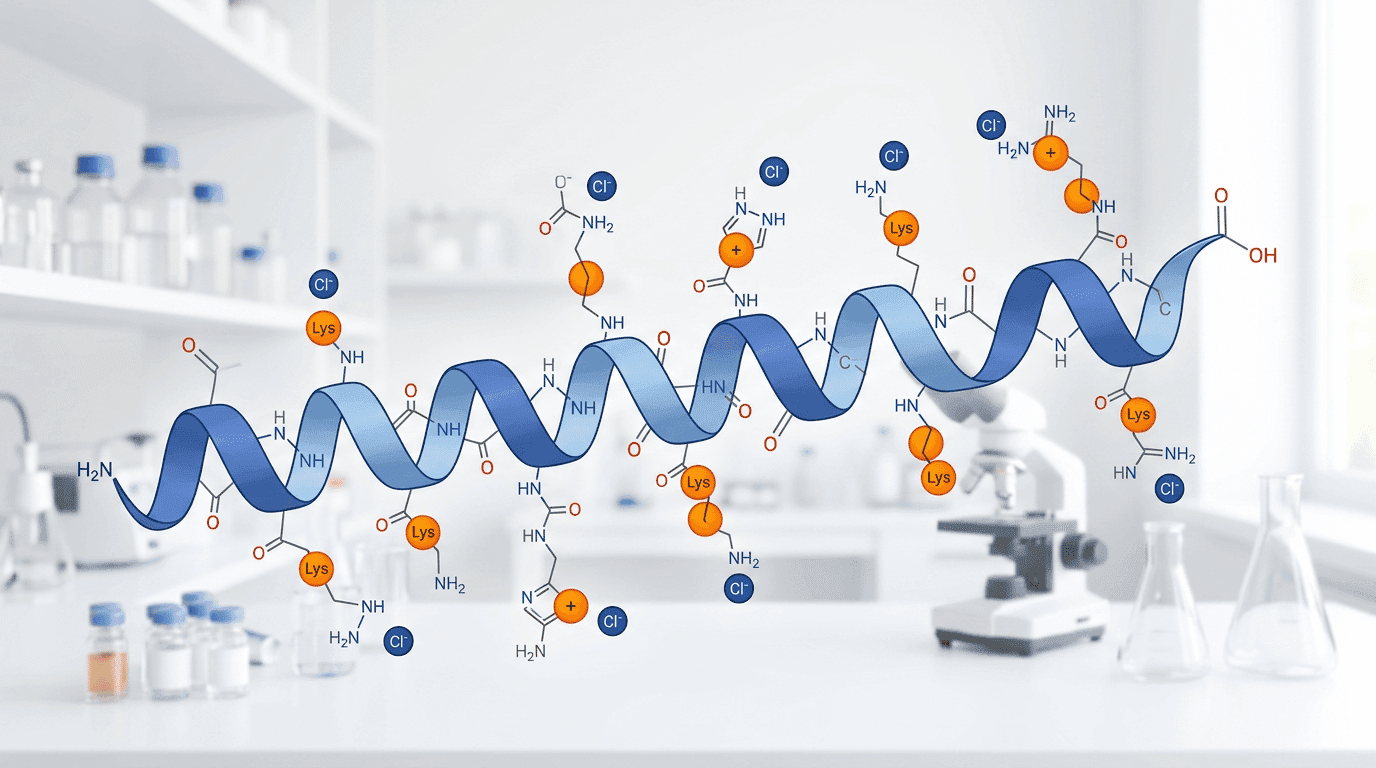
A counter-ion is an ion of opposite charge that balances a charged molecule so the overall species is neutral. A research peptide is rarely a single neutral molecule in isolation. Instead, it exists as a salt: the peptide carries charges, and counter-ions pair with those charges.
Those charges come from specific amino acid residues. The side chains of lysine (Lys), arginine (Arg), and histidine (His), along with the free N-terminus, can carry a positive charge. Each positive site needs a negatively charged partner to balance it, and that partner is the counter-ion.
This is why a peptide rich in basic residues carries more counter-ion mass than a peptide with few charged sites. The number of charged positions sets the number of counter-ions, and the counter-ions become part of the lyophilized powder that arrives in the vial. A peptide with no basic residues and a blocked N-terminus may carry almost no counter-ion at all.
The practical consequence appears later, on the documentation. The counter-ion is real mass, it is weighed with the product, and it is not the peptide. Recognizing that the powder is a salt rather than a pure compound is the foundation for everything that follows.
Why TFA Is the Default Counter-Ion in Fmoc Solid-Phase Synthesis
Most research peptides arrive as trifluoroacetate (TFA) salts, and the reason is procedural rather than chosen. Trifluoroacetic acid appears twice in the standard workflow. It serves as the cleavage agent that releases the finished peptide from its resin support, and it serves as the ion-pairing reagent in the reversed-phase HPLC step used to purify the product (Pharmaceuticals, 2025).
Because the peptide is exposed to trifluoroacetic acid during both solid-phase peptide synthesis cleavage and purification, it picks up trifluoroacetate counter-ions and isolates as a TFA salt by default. The vast majority of low molecular weight peptides produced by solid-phase protocols form a TFA salt for exactly this reason (Journal hosted on PubMed Central, 2025).
TFA has genuinely useful properties for production, which is why it dominates the field. It improves solubility during purification and sharpens chromatographic separation. The default is a feature of an efficient process, not an oversight.
The amount of trifluoroacetate that ends up bound is not trivial and scales with charge. In one analysis of antimicrobial peptides obtained as TFA salts, trifluoroacetate content ranged from 150 to 320 micrograms per milligram of peptide sample (PubMed Central, 2018). For a peptide carrying several basic residues, the counter-ion can therefore represent a meaningful fraction of the total powder weight.
When Acetate or Another Salt Form Matters
A TFA salt can be converted to a different salt form after synthesis. The most common alternative is acetate, produced by an additional counter-ion exchange step. In practice this is achieved by binding the purified peptide to a column, washing with an acetate-containing buffer in place of trifluoroacetic acid, and eluting the exchanged product (United States Patent and Trademark Office, 2020).
The reason this matters is that the counter-ion is not a passive bystander. Counter-ions can influence the physicochemical and functional behaviour of a peptide, which is why current scientific consensus is that the salt form should be explicitly reported in any peptide study rather than left unstated (Pharmaceuticals, 2025). Two preparations of the same sequence in different salt forms can differ in measurable properties such as aqueous solubility.
This effect is significant enough that different salts of the same peptide can be treated as distinct chemical entities, and most peptides that progress beyond early research are supplied as hydrochloride or acetate salts even though early research itself is typically centred on TFA salts (Journal hosted on PubMed Central, 2025).
One caveat is worth stating plainly. Counter-ion exchange reduces residual trifluoroacetate but does not always eliminate it completely. Even after repeated exchange cycles, a small amount of trifluoroacetate can remain bound (Pharmaceuticals, 2025). A peptide described as an acetate salt may still carry trace TFA, which is why a quantified counter-ion figure on the documentation is more informative than the salt name alone.
TFA Salt and Acetate Salt at a Glance
Attribute | TFA salt | Acetate salt |
|---|---|---|
Origin | Default from standard Fmoc synthesis and HPLC | Produced by an added exchange step |
Counter-ion mass | Heavier (trifluoroacetate, roughly 113 g/mol) | Lighter (acetate, roughly 59 g/mol) |
Effect on net peptide content | Lower at equal counter-ion stoichiometry | Higher at equal counter-ion stoichiometry |
Reporting | Counter-ion content should be quantified on the COA | Counter-ion content should be quantified on the COA; residual TFA may persist |
At equal counter-ion stoichiometry, the lighter acetate ion carries less dead mass than trifluoroacetate, so an acetate salt holds slightly more peptide per unit weight than the equivalent TFA salt.
How Counter-Ions Affect COA Interpretation and Net Peptide Content
This is where the chemistry becomes a number a researcher uses. The most common point of confusion is the difference between purity and net peptide content, and counter-ions sit at the centre of it.
HPLC purity measures the target peptide against other peptide-related species, such as deletion or truncation sequences. It does not account for water or counter-ions, because those are not chromophores the assay is measuring. A peptide can therefore report very high HPLC purity while a substantial portion of the powder by weight is still counter-ion and moisture.
Net peptide content answers the separate question of how much of the total powder is actually peptide. The remainder is everything else: counter-ions, bound water, and residual solvents. The two figures describe different things, and both are needed to prepare an accurate solution.
A useful cross-check is the mass balance approach. When peptide content, counter-ion content, and water content are summed, the total should approach 100 percent, which confirms that no significant unaccounted impurity remains. This is the same principle used to assign purity to pharmacopeial peptide reference standards, where the assigned value is derived by measuring all detectable impurities and subtracting them from 100 percent (PubMed Central, 2019).
A simple worked estimate shows the scale of the effect. Consider a peptide of molecular weight 1000 with a free N-terminus and a single arginine residue, giving two charged sites and therefore two trifluoroacetate counter-ions at roughly 114 g/mol each. The theoretical net peptide content is 1000 divided by (1000 plus 2 times 114), which equals approximately 81 percent. In that example, almost one fifth of the weight is counter-ion before water is even considered.
The implication for laboratory work is direct. If a researcher assumes the entire labelled mass of a vial is peptide, the amount of peptide present will be overstated. For quantitative assays, stoichiometric work, and any comparison across lots or suppliers, the net peptide content from the Certificate of Analysis is the figure that should drive the calculation.
Reading Counter-Ion Information on a COA
A complete COA gives a researcher the inputs needed to account for counter-ion mass rather than guess at it. The following elements work together.
COA element | What it tells you |
|---|---|
Salt form / counter-ion identity | Whether the product is a TFA, acetate, or other salt |
Counter-ion content (%) | How much of the powder is counter-ion |
Water content | Moisture captured by the hygroscopic powder, often higher for basic or hydrophilic sequences |
Net peptide content (%) | The actual peptide fraction of the labelled mass |
When these values are present, the mass balance check becomes possible and the net peptide content becomes trustworthy. Where a certificate does not report these values, the labelled mass is an upper limit on the peptide present, and any peptide quantity taken from it will be overstated.
Where a certificate reports counter-ion, water and net peptide figures, they support accurate experimental preparation and reproducibility, which is the entire purpose of reporting them.
Frequently Asked Questions
What is a counter-ion in a peptide?
A counter-ion is a charged species that balances the charges on a peptide so the overall salt is neutral. Charged sites such as lysine, arginine, histidine side chains, and the free N-terminus each pair with a counter-ion, which becomes part of the lyophilized powder.
Why are research peptides usually TFA salts?
Trifluoroacetic acid is used both to cleave the finished peptide from its resin and as the ion-pairing reagent during reversed-phase HPLC purification. As a result, peptides made by standard Fmoc solid-phase synthesis isolate as trifluoroacetate salts by default (Pharmaceuticals, 2025).
Is an acetate salt better than a TFA salt?
Neither is universally better. The salt form influences physicochemical and functional properties, so the appropriate choice depends on the laboratory application, and the current recommendation is simply that the salt form be reported explicitly (Pharmaceuticals, 2025). Acetate also carries less counter-ion mass than trifluoroacetate at equal stoichiometry.
Why does HPLC purity differ from net peptide content?
HPLC purity compares the target peptide against other peptide-related species and ignores water and counter-ions. Net peptide content measures the actual peptide fraction of the whole powder. A peptide can be high in HPLC purity yet lower in net peptide content because of counter-ion and water mass.
Does counter-ion content affect how much peptide a vial contains?
Yes. Counter-ions add weight that is not peptide, so a vial contains less actual peptide than the labelled gross mass. The net peptide content figure from the COA gives an accurate account of the peptide present for quantitative laboratory work.
Can residual TFA remain in an acetate salt?
Yes. Counter-ion exchange reduces trifluoroacetate but does not always remove it entirely, and trace amounts can persist after repeated exchange cycles (Pharmaceuticals, 2025). A quantified counter-ion value on the documentation is more informative than the salt name alone.
Key Takeaways
Every charged research peptide exists as a salt, and the counter-ion balances charges from lysine, arginine, histidine, and the free N-terminus.
TFA is the default counter-ion because trifluoroacetic acid is used in both cleavage and HPLC purification during standard solid-phase synthesis.
Counter-ion content scales with the number of basic residues and can represent a meaningful fraction of total powder weight.
Net peptide content, not HPLC purity, tells a researcher how much actual peptide is in the vial, and the two figures answer different questions.
A mass balance check, summing peptide, counter-ion, and water content toward 100 percent, confirms a COA accounts for the full composition.
Check What Each Certificate Reports
Each certificate posted on the lab results page reports HPLC purity and assay, an ICP-MS panel for arsenic, cadmium, lead and mercury, LAL endotoxin and USP <71> sterility for a single lot. Check that the lot on the certificate matches the lot on your vial.