Date
Category
BPC-157 is a synthetic pentadecapeptide that appears frequently in laboratory research literature, yet its underlying chemistry is often described inconsistently across the internet. This article sets out what is actually established about the compound: its molecular structure, the amino acid sequence that defines it, how peptides of this kind are synthesized, and what published laboratory studies have reported. The aim is a clear, documentation-first reference for researchers who want the chemistry stated accurately.
This article is provided for informational and educational purposes only and does not constitute medical, pharmaceutical, or legal advice. The compound discussed is intended for laboratory research purposes only and is not for human or animal consumption. It is not intended to diagnose, treat, cure, or prevent any disease.
At Janera Science, the priority is to present research materials with the same accuracy and traceability expected in any scientific setting. That begins with getting the chemistry right.
What Is BPC-157?
BPC-157 is a synthetic peptide composed of fifteen amino acids, which places it in the class of compounds known as pentadecapeptides. Its name is an abbreviation of "Body Protection Compound 157," and it corresponds to a partial sequence of a larger protective protein originally isolated from human gastric juice (Sikiric et al., 2011).
In the scientific literature the compound also appears under several development designations, including PL 14736, PL-10, PLD-116, and bepecin. These alternate names trace back to its early characterization and to subsequent patent and research filings (Multifunctionality of BPC 157, Literature and Patent Review, 2025).
It is important to be precise about a single point that is widely misstated: BPC-157 is a synthetic laboratory compound, and it has been studied primarily in cellular assays and animal models. It is not an approved drug in any jurisdiction, a point reflected in the research-supply standards described on the About page.
BPC-157 Molecular Structure
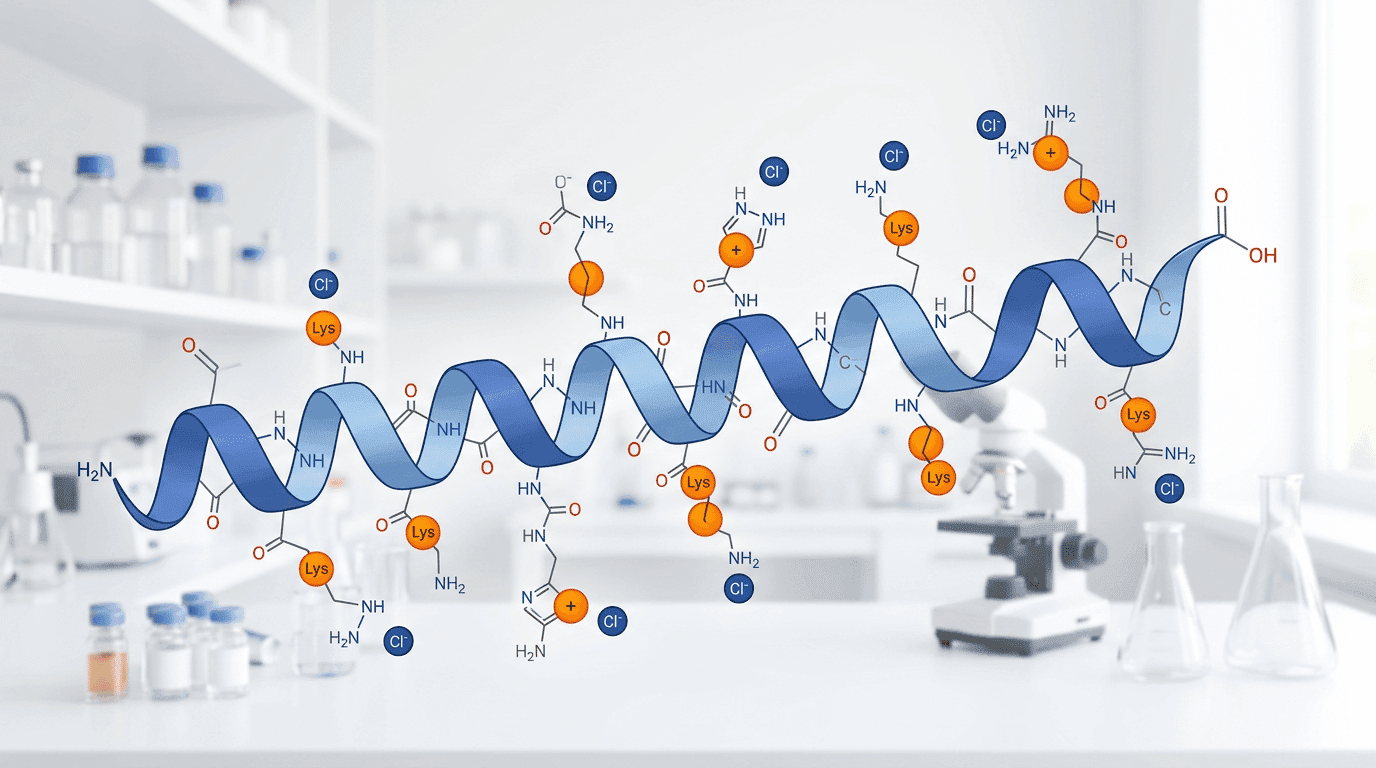
The molecular structure of BPC-157 is fully defined and registered in public chemical databases. The compound carries the molecular formula C62H98N16O22 and a molecular weight of approximately 1,419.5 g/mol, and it is catalogued in the PubChem database under CID 9941957 (PubChem, NIH).
The fifteen residues are arranged in the following order:
Gly – Glu – Pro – Pro – Pro – Gly – Lys – Pro – Ala – Asp – Asp – Ala – Gly – Leu – Val
The table below summarizes the standardized chemical identifiers that allow a research material to be verified consistently across laboratories.
Property | Value |
|---|---|
Compound class | Synthetic pentadecapeptide (15 amino acids) |
Molecular formula | C62H98N16O22 |
Molecular weight | ~1,419.5 g/mol |
CAS number | 137525-51-0 |
PubChem CID | 9941957 |
Amino acid sequence | Gly-Glu-Pro-Pro-Pro-Gly-Lys-Pro-Ala-Asp-Asp-Ala-Gly-Leu-Val |
A notable structural feature is the compound's proline content. The sequence contains four proline residues, including three positioned consecutively near the N-terminus. Proline imposes conformational constraints on a peptide backbone, and the published literature consistently describes BPC-157 as a stable gastric pentadecapeptide that has been reported to remain intact in human gastric juice (Sikiric et al., 2011).
When reviewing chemical records, researchers will sometimes encounter a sixteen-residue listing with an extra proline. This is a transcription error that propagates between secondary sources. The verified fifteen-residue sequence is the one consistent with the registered molecular formula and weight.
How Research Peptides Like BPC-157 Are Synthesized
BPC-157 is produced by chemical synthesis rather than extraction. The standard approach for peptides of this length is solid-phase peptide synthesis (SPPS), a method introduced by R. Bruce Merrifield, who received the 1984 Nobel Prize in Chemistry for the work (Chemistry LibreTexts). SPPS remains the method of choice for synthesizing peptides for both research and production purposes (SPPS review, 2024).
The principle is to anchor the first amino acid to an insoluble polymer resin, then build the chain one residue at a time while it stays bound to the solid support. Each cycle repeats the same sequence of steps: deprotect the reactive group on the growing chain, couple the next protected amino acid, and wash away excess reagents before the next addition (Iowa State University Protein Facility).
Two protecting-group strategies dominate the field. The Boc approach relies on acid-based deprotection, while the Fmoc approach combines base sensitivity with acid sensitivity and avoids the more hazardous reagents associated with Boc chemistry. For that reason, Fmoc chemistry has become the more widely adopted route for routine peptide production (SPPS review, 2024).
Once the full sequence is assembled, the peptide is cleaved from the resin, the side-chain protecting groups are removed, and the crude material is purified. Identity and purity are then confirmed analytically, typically by reverse-phase high-performance liquid chromatography (RP-HPLC) for purity and mass spectrometry for sequence confirmation. These verification steps are the foundation of a meaningful certificate of analysis, a topic explored further in our guide on what a certificate of analysis tells researchers and on the lab results page.
BPC-157 in Published Research
Published work on BPC-157 has been conducted almost entirely in cellular assays and animal models. The summaries below describe what specific studies reported in those laboratory contexts. They are not statements about effects in humans, and no such extrapolation should be inferred.
In a 2011 study published in the Journal of Applied Physiology, researchers examined the compound using rat Achilles tendon explants and cultured tendon fibroblasts. They reported that explants cultured in a BPC-157-containing medium showed accelerated fibroblast outgrowth relative to untreated controls, while a standard assay indicated no direct effect on cell proliferation. The same group reported increased fibroblast survival under oxidative stress and dose-dependent cell migration in a transwell assay, observations the authors associated with focal adhesion kinase signaling (Chang et al., 2011).
A 2014 follow-up study from the same research group, published in Molecules, used cDNA microarray analysis on tendon fibroblasts isolated from rat Achilles tendon. The authors reported dose- and time-dependent changes in growth hormone receptor expression at both the messenger RNA and protein levels in those cultured cells (Chang et al., 2014).
Pharmacokinetic characterization has also been reported. A 2022 study in Frontiers in Pharmacology tracked radiolabeled BPC-157 in rats and dogs, describing how the peptide was distributed and metabolized and reporting that it was ultimately broken down into individual amino acids, with proline among the identified components (Frontiers in Pharmacology, 2022).
Broader reviews have catalogued the preclinical literature on the compound across a range of laboratory models. A 2019 review in Cell and Tissue Research surveyed work on the pentadecapeptide in musculoskeletal soft-tissue research (Gwyer, Wragg, and Wilson, 2019). For readers building familiarity with how this kind of literature is structured, the published research category collects further compound-level overviews, including the chemistry of GHK-Cu.
Regulatory Context and Research Use Only Status
Understanding the regulatory standing of BPC-157 is part of understanding the compound itself. In 2022, the World Anti-Doping Agency added BPC-157 by name to section S0, Non-Approved Substances, of its Prohibited List, the first time a substance had been included by name as an example in that section (WADA, 2021).
From a drug-approval standpoint, the compound is not recognized as an approved therapeutic agent. It does not appear in the U.S. Food and Drug Administration's database of approved drugs, and it is not a recognized dietary ingredient (OPSS, U.S. Department of Defense). Anti-doping authorities have likewise noted that there is no established basis for selling it as a drug, food, or dietary supplement (USADA, 2021).
This is precisely why a compound like BPC-157 is supplied strictly as a research material. The Research Use Only designation reflects its actual status: a laboratory compound for controlled scientific investigation, not a product for personal use. Common questions about the compound and about ordering are addressed in the FAQ.
Key Takeaways
BPC-157 is a synthetic pentadecapeptide of fifteen amino acids, with the molecular formula C62H98N16O22 and a molecular weight of approximately 1,419.5 g/mol (PubChem CID 9941957).
Its verified sequence is Gly-Glu-Pro-Pro-Pro-Gly-Lys-Pro-Ala-Asp-Asp-Ala-Gly-Leu-Val; a sixteen-residue version circulating online is a transcription error.
The compound corresponds to a partial sequence of a larger protein originally isolated from human gastric juice.
Peptides of this length are produced by solid-phase peptide synthesis, then purified by RP-HPLC and verified by mass spectrometry.
Published studies on BPC-157 have been carried out in cellular and animal models; findings should not be extrapolated to humans.
BPC-157 was added to the WADA Prohibited List in 2022 and is not an approved drug or dietary ingredient, which is why it is supplied strictly for laboratory research use.
Frequently Asked Questions
What is BPC-157?
BPC-157 is a synthetic pentadecapeptide made up of fifteen amino acids. Its name stands for Body Protection Compound 157, and it corresponds to a partial sequence of a larger protein originally isolated from human gastric juice. It is a laboratory research compound and is not an approved drug.
What is the molecular formula and weight of BPC-157?
BPC-157 has the molecular formula C62H98N16O22 and a molecular weight of approximately 1,419.5 g/mol. It is registered in the PubChem database under CID 9941957 and carries the CAS number 137525-51-0.
What is the amino acid sequence of BPC-157?
The fifteen-residue sequence is Gly-Glu-Pro-Pro-Pro-Gly-Lys-Pro-Ala-Asp-Asp-Ala-Gly-Leu-Val. The sequence includes four proline residues, three of which are positioned consecutively near the N-terminus.
How is BPC-157 synthesized?
Like most research peptides of its length, BPC-157 is produced by solid-phase peptide synthesis. The chain is assembled one amino acid at a time on an insoluble resin using Fmoc or Boc protecting-group chemistry, then cleaved, purified by reverse-phase HPLC, and verified by mass spectrometry.
What does the published research on BPC-157 involve?
Published studies on BPC-157 have been conducted in cellular assays and animal models, examining areas such as tendon fibroblast behavior in culture and pharmacokinetics in rats and dogs. These are laboratory observations and do not establish effects in humans.
What does "Research Use Only" mean for BPC-157?
Research Use Only indicates that a material is intended exclusively for laboratory research and is not approved for human or animal use. BPC-157 is not an FDA-approved drug or a recognized dietary ingredient, and it was added to the WADA Prohibited List in 2022, which is consistent with its status as a research-only compound.
This content is provided for informational and educational purposes only. The compound discussed is intended for laboratory research purposes only and is not for human or animal consumption. It is not intended to diagnose, treat, cure, or prevent any disease.
See Documented Analyses for Every Product
Now that you know how a research peptide is assembled, here is what stands behind ours. Janera publishes a current, batch-specific certificate of analysis for every peptide in the catalogue. Identity confirmation, HPLC purity, mass-spectrometric verification, and full lot traceability. Open and downloadable.