
Date
Category
TB-500 and thymosin beta-4 are routinely treated as a single compound, yet they are two distinct molecules with different sizes, structures, and chemical identities. The names are used interchangeably so often that the difference between a full protein and a short synthetic fragment is frequently lost. For laboratories that depend on knowing exactly what is in a vial, that distinction is not a technicality. It changes the molecular weight, the sequence, the registry identifier, and how a compound behaves in an assay.
This article clarifies the chemistry that separates the two, working strictly from the published literature and the molecular record.
This content is provided for informational and educational purposes only and does not constitute medical, pharmaceutical, or legal advice. The products discussed are intended for laboratory research purposes only and are not for human or animal consumption. They are not intended to diagnose, treat, cure, or prevent any disease.
Two names, one source of confusion
Thymosin beta-4 (Tβ4) is a naturally occurring peptide. TB-500 is a synthetic molecule that corresponds to a short region of that peptide. They are chemically related, but they are not identical, and the literature is precise about why.
The confusion has an understandable origin. TB-500 was named after the active region of thymosin beta-4, so the two terms drifted together in informal use. The molecular reality is that one is a 43-amino-acid protein and the other is a synthetic seven-residue fragment. Treating them as interchangeable is the kind of ambiguity that careful documentation exists to remove.
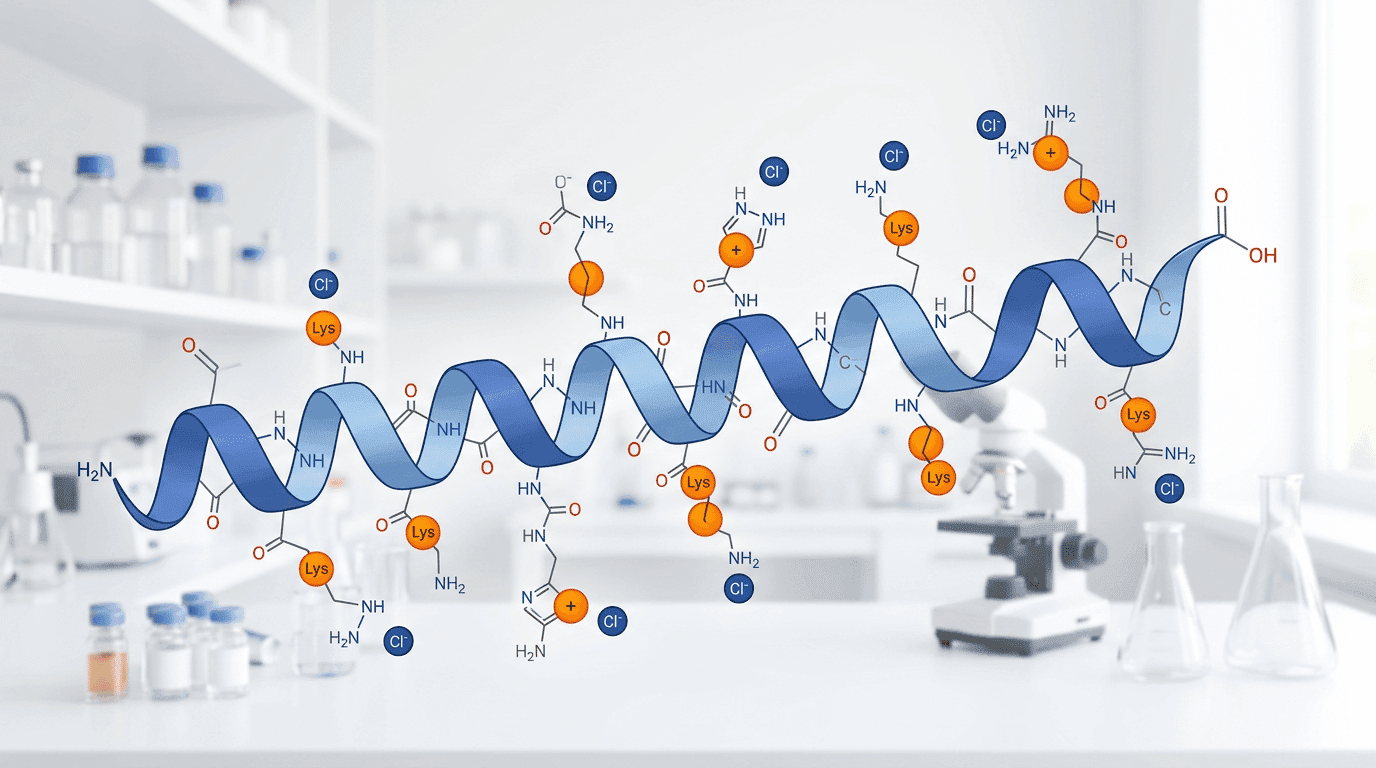
Thymosin beta-4: structure of the full peptide
Thymosin beta-4 is a water-soluble polypeptide of 43 amino acids with a molecular mass of approximately 4.9 kilodaltons, ubiquitously expressed and highly conserved across species (Journal of Biological Chemistry, 2011). It is widely described in the literature as the major actin-sequestering molecule in eukaryotic cells (Trends in Molecular Medicine, 2005). The complete amino acid sequence was first established in 1981 (PNAS, 1981).
The human sequence runs SDKPDMAEIEKFDKSKLKKTETQEKNPLPSKETIEQEKQAGES, and its N-terminus is blocked by an acetyl group (Thymosin beta-4, Wikipedia). Within that chain sits the segment most relevant to this discussion. The motif LKKTET begins at residue 17 and is strongly conserved across the broader beta-thymosin family, which is why it is commonly called the actin-binding motif.
A key point of nuance is that the binding is not confined to those few residues. Structural modeling based on X-ray crystallography indicates that essentially the entire length of the beta-thymosin sequence contacts actin in the complex (Thymosin beta-4, Wikipedia). The short motif names the region, but the whole molecule participates in the interaction.
Thymosin beta-4 at a glance
Property | Value |
|---|---|
Class | Naturally occurring polypeptide |
Length | 43 amino acids |
Molecular weight | Approximately 4.9 kDa (around 4,960 Da) |
N-terminus | Acetylated |
Isoelectric point | Approximately 5.1 |
CAS number | 77591-33-4 |
Documented role | Major G-actin-sequestering molecule in eukaryotic cells |
TB-500: the N-terminal acetylated 17 to 23 fragment
TB-500 is a synthetic heptapeptide. Analytical work using high-resolution mass spectrometry identified the species marketed under that name as Ac-LKKTETQ, the N-terminal acetylated 17 to 23 fragment of human thymosin beta-4 (Drug Testing and Analysis, 2012). In other words, TB-500 reproduces the conserved actin-binding region of the parent protein and nothing else.
Because it contains only that short region, TB-500 is far smaller and structurally simpler than the full molecule. Its molecular formula is C38H68N10O14, with a molecular weight of approximately 889 g/mol and the registry identifier CAS 885340-08-9 (TB-500, Wikipedia). The same study that confirmed its identity also prepared the fragment by solid-phase peptide synthesis, the standard route for assembling defined research peptides (Drug Testing and Analysis, 2012).
The acetyl group on the N-terminus carries a useful consequence for analytical chemistry. Because the synthetic fragment is acetylated and truncated, it can be distinguished from the body's own thymosin beta-4 in laboratory specimens, which is the basis of the detection methods developed in the literature (Drug Testing and Analysis, 2012).
TB-500 at a glance
Property | Value |
|---|---|
Class | Synthetic heptapeptide fragment |
Sequence | Ac-LKKTETQ (residues 17 to 23 of thymosin beta-4) |
Molecular formula | C38H68N10O14 |
Molecular weight | Approximately 889 g/mol |
N-terminus | Acetylated |
CAS number | 885340-08-9 |
Why a fragment is not the parent protein
The most important chemical lesson in this comparison is that a fragment does not automatically behave like the molecule it was taken from. Structure and function are linked in ways that a short sequence does not always capture on its own.
This was demonstrated directly in laboratory assays. Full-length thymosin beta-4 sequesters G-actin at a one-to-one ratio and thereby inhibits its polymerization into filamentous actin (Biological Chemistry Hoppe-Seyler, 1993). Yet when researchers tested truncated versions, neither the 24 to 43 fragment nor the 13 to 43 fragment inhibited actin polymerization in the same assay. The investigators concluded that structural features in the region before residue 13 are obligatory for that function (Biological Chemistry Hoppe-Seyler, 1993).
The broader research literature points the same way, with work showing that distinct biological activities of thymosin beta-4 can be localized to specific short sequences within the molecule rather than to the protein as an undivided whole (FASEB Journal, 2010). The practical reading for an experimentalist is straightforward. The full 43-residue protein and a 7-residue acetylated fragment are separate research entities, and an experiment designed around one should not silently assume the behavior of the other.
What the distinction means for research documentation
For a laboratory, the value of this comparison is reproducibility. Two compounds that share a name but differ in length, mass, formula, and registry number will not necessarily produce comparable results, and a protocol that does not specify which one was used invites ambiguity months later when the data is reviewed.
This is where identity verification earns its place. A molecular weight near 889 g/mol and a single defined sequence describe the fragment, while a mass near 4.9 kDa describes the full protein, and a documentation trail should make clear which was on the bench. At Janera Science, the emphasis on identity and purity verification exists for exactly this reason, because removing uncertainty about what a vial contains is a precondition for sound research. Confirming a compound against its Certificate of Analysis is the most direct way to close that gap, and the supporting lab results provide the record behind it.
The same chemistry-first approach runs through other compounds in the catalog, including the coordination chemistry covered in our discussion of copper peptide chemistry. Readers with practical questions can review the frequently asked questions, and the wider published research collection gathers the literature these articles draw on. View verified Janera Science TB-500 lab results.
Frequently Asked questions
Is TB-500 the same as thymosin beta-4?
No. Thymosin beta-4 is a naturally occurring 43-amino-acid polypeptide, while TB-500 is a synthetic 7-amino-acid fragment, identified in analytical work as the N-terminal acetylated 17 to 23 region (Ac-LKKTETQ) of that protein (Drug Testing and Analysis, 2012). They are chemically related but distinct molecules.
What is the amino acid sequence of TB-500?
TB-500 corresponds to the sequence Ac-LKKTETQ, meaning an acetylated chain of leucine, lysine, lysine, threonine, glutamic acid, threonine, and glutamine (TB-500, Wikipedia). This is the segment found at positions 17 to 23 of full-length thymosin beta-4.
What does the "Ac" in Ac-LKKTETQ mean?
The "Ac" denotes acetylation of the N-terminus, a modification in which an acetyl group is attached to the front of the peptide chain. In thymosin beta-4 the N-terminus is also acetylated, and in the synthetic fragment the acetyl group additionally serves as an analytical marker that helps distinguish the synthetic species from endogenous protein (Drug Testing and Analysis, 2012).
What are the molecular weights of TB-500 and thymosin beta-4?
TB-500 has a molecular weight of approximately 889 g/mol with the formula C38H68N10O14 (TB-500, Wikipedia). Thymosin beta-4 is much larger, at approximately 4.9 kilodaltons across its 43 residues (Journal of Biological Chemistry, 2011).
Does a fragment behave the same as the full protein?
Not necessarily. In laboratory assays, full-length thymosin beta-4 sequestered G-actin at a one-to-one ratio, whereas certain truncated fragments did not inhibit actin polymerization, indicating that regions outside the short motif contribute to function (Biological Chemistry Hoppe-Seyler, 1993). This is the central reason the two should be treated as separate research entities.
What does Research Use Only mean?
Research Use Only (RUO) indicates that a product is intended exclusively for laboratory research. RUO materials are not approved for human or animal use and are not intended to diagnose, treat, cure, or prevent any disease.
Key Takeaways
Thymosin beta-4 is a naturally occurring 43-amino-acid polypeptide of approximately 4.9 kDa, widely described as the major actin-sequestering molecule in eukaryotic cells.
TB-500 is a synthetic heptapeptide, identified as the acetylated 17 to 23 fragment Ac-LKKTETQ, with a molecular weight near 889 g/mol and formula C38H68N10O14.
The two share a conserved actin-binding region but differ in length, mass, molecular formula, and CAS number.
Laboratory evidence shows that fragments of thymosin beta-4 do not always reproduce the actin behavior of the full protein, so the fragment and the parent are distinct research entities.
Clear identity and purity documentation is the practical safeguard against the name-based confusion this comparison addresses.
This content is provided for informational and educational purposes only and does not constitute medical, pharmaceutical, or legal advice. The products discussed are intended for laboratory research purposes only and are not for human or animal consumption.
See Documented Analyses for Every Product
Now that you know how a research peptide is assembled, here is what stands behind ours. Janera publishes a current, batch-specific certificate of analysis for every peptide in the catalogue. Identity confirmation, HPLC purity, mass-spectrometric verification, and full lot traceability. Open and downloadable.