Restricted Access
This website is intended strictly for qualified research professionals. All products are sold for in-vitro laboratory research use only and are not intended for human or veterinary use.
Statements have not been evaluated by the U.S. Food and Drug Administration. Products are not intended to diagnose, treat, cure, or prevent any disease. Janera Science is not a 503A compounding pharmacy or 503B outsourcing facility.


Date
Category
Verifying a supplier's purity claim comes down to five checks: read what the purity number measures, match the certificate to your lot, confirm the laboratory is accredited for the test it ran, look for an identity result beside the purity result, and, where the work justifies it, commission peptide lab testing of your own sealed vial. Each check can be run against any supplier, and each one closes a different gap.
All Janera Science compounds are supplied strictly for in-vitro laboratory research use only. They are not intended for human or veterinary use, and are not intended to diagnose, treat, cure, or prevent any disease. The statements made on this website have not been evaluated by the U.S. Food and Drug Administration.
Step 1: Read What "99 Percent Purity" Actually Measures
An HPLC purity figure is the share of the detected chromatographic peak area that belongs to the main peptide peak. Scientists at the United States Pharmacopeia (USP), working with the UK medicines regulator, describe HPLC impurities as measured as a percentage of the total detected area, and chromatographic purity is what is left of that 100 percent (McCarthy et al., 2023).
For its peptide reference standards, USP measures the counter-ion, trifluoroacetic acid, residual solvents and inorganic residue separately by weight, and water by Karl Fischer titration, outside the HPLC area-percent figure, and takes them out to work out how much of the material is peptide (McCarthy et al., 2023). Our guide to peptide purity testing explains how area purity differs from net peptide content, and our guide to counter-ions covers where the rest of the mass comes from.
Purity, content, counter-ion and water are four different numbers
A certificate can report any of these, so check which one you are reading.
Figure on a certificate | Question it answers | How USP measures it |
|---|---|---|
Purity (area percent) | What share of the detected material is the target peptide? | Reversed-phase HPLC with UV detection |
Peptide content or assay | How much actual peptide is in the material? | Mass balance on the bulk material, then HPLC assay of vials against it |
Counter-ion content | How much of the weight is counter-ion, such as acetate? | Separate HPLC methods for the counter-ion and trifluoroacetic acid |
Water content | How much of the weight is water? | Karl Fischer titration |
Methods source: McCarthy et al., 2023.

A purity figure is only as good as the method behind it
An impurity that co-elutes with the main peak does not show as a separate peak, so a UV purity figure counts it as the target peptide. Scientists at the U.S. Food and Drug Administration (FDA) reported a synthetic peptide drug product containing an amino acid deletion and an amino acid insertion that could not be resolved using the HPLC-UV methods the applicant had submitted (Zeng et al., 2015).
So check that the method is named and the chromatogram shown. A bare percentage gives a reader nothing to evaluate.
Step 2: Ask for a Certificate That Matches Your Lot
A certificate of analysis (COA) is evidence for one production lot, so its lot number has to match the lot number on your vial exactly.
The International Council for Harmonisation (ICH) good manufacturing practice guide for active pharmaceutical ingredients asks that impurity profiles be compared at appropriate intervals against the regulatory submission or historical data, to detect changes from modifications in raw materials, equipment operating parameters or the production process (International Council for Harmonisation, 2000). A certificate reused from lot to lot says little about the vial in your hand.
What a laboratory report should show
Under ISO/IEC 17025, unless there is a valid reason to leave something out, a laboratory's report must include items such as the laboratory's name and address, a unique identification for the report, the method used, an unambiguous identification of the item tested, the results, and a statement that the results relate only to the items tested (NIST, 2018).
A supplier's COA without the laboratory's name, method or report number has removed the fields a reader needs to check it. Our guide to reading a peptide COA takes the fields one at a time.
Step 3: Confirm the Laboratory Exists and Is Accredited for That Test
ISO/IEC 17025 is the international standard setting general requirements for the competence of testing and calibration laboratories (International Organization for Standardization, 2017), and accreditation to it covers specific tests.
NIST's National Voluntary Laboratory Accreditation Program (NVLAP), whose requirements encompass ISO/IEC 17025, accredits laboratories based on their competence to carry out specific calibrations or tests, formalized in a Certificate of Accreditation and a Scope of Accreditation (NIST). An accreditation logo says the laboratory is accredited for something. The scope says for what.
How to run the check
Find the laboratory's name and address, and confirm independently that it operates there.
Find the accreditation body and certificate number behind any accreditation mark.
Confirm the accreditation body is recognized. Signatories to the International Laboratory Accreditation Cooperation (ILAC) Mutual Recognition Arrangement have been peer evaluated against ISO/IEC 17011, and ILAC publishes a list showing the scope of each one's recognition (ILAC). Check that it covers ISO/IEC 17025 testing.
Open the scope and look for the method on your certificate, such as HPLC purity or mass spectrometry identity.
Ask the laboratory directly whether it issued the report, quoting the report number.
What a third-party laboratory can vouch for
Where the laboratory was not responsible for sampling, ISO/IEC 17025 requires the report to state that the results apply to the sample as received, and a report must carry a disclaimer where information the customer supplied can affect the validity of the results (ISO/IEC 17025:2017, clause 7.8.2.2). Whether that sample represents the lot is the gap Step 5 closes.
Step 4: Look for an Identity Result Beside the Purity Result
Purity tells you how much of the detected material is the main component. Identity tells you whether that main component is the molecule on the label, and mass spectrometry, which measures the molecule's mass, is one of the standard tests for it (McCarthy et al., 2023). A certificate reporting only purity has left the more basic question open.
USP typically confirms the identity of its peptide reference standards with several orthogonal methods, including NMR and liquid chromatography with tandem mass spectrometry (McCarthy et al., 2023). A research certificate may not carry that full set. The minimum worth asking for is an observed molecular mass beside the expected mass, with the spectrum available. Our guide to purity testing by HPLC and mass spectrometry covers how the instrument arrives at that figure.

Step 5: Commission Independent Peptide Lab Testing
Independent peptide lab testing means buying a vial through the normal channel, keeping it sealed, and sending it to an accredited laboratory you chose yourself for identity and purity analysis. It is the only step on this list that tests your material rather than a supplier's paperwork.
When Belgium's Scientific Institute of Public Health screened the ten most frequently encountered falsified peptide drugs on the Belgian market, acquired from three suspected illegal internet pharmacies, it found high variation in the amount per unit, and purities between 5 and 75 percent for the cysteine-containing peptides (Janvier et al., 2018). As the authors note, falsified preparations like these are produced outside the legally required quality systems.
How to get a peptide lab tested
Order through the ordinary checkout. A vial requested as a test sample may be selected differently.
Record the lot number, photograph the label and keep the vial sealed.
Choose a laboratory that passes the Step 3 check for the tests you need.
Request mass spectrometry for identity and HPLC for purity. Add peptide content if your work depends on how much peptide is in the vial.
Ask for the raw data: the chromatogram and the mass spectrum.
Compare against the supplier's certificate for the same lot.
Reading the comparison
A mass that does not match the expected value needs an explanation before the material is used. A small gap between two purity figures deserves a look at both methods first. Separation depends on the method, and ICH gives the example that, for critical separations in chromatography, specificity can be demonstrated by resolving the two components that elute closest to each other (International Council for Harmonisation, 2023). Content figures can move too, because a peptide's water content can differ with humidity during testing (McCarthy et al., 2023).
Red Flags That End the Evaluation Early
Some findings settle the question before any money is spent on testing.
No lot number, or a lot number that differs from the vial.
One certificate reused across strengths, products or lots.
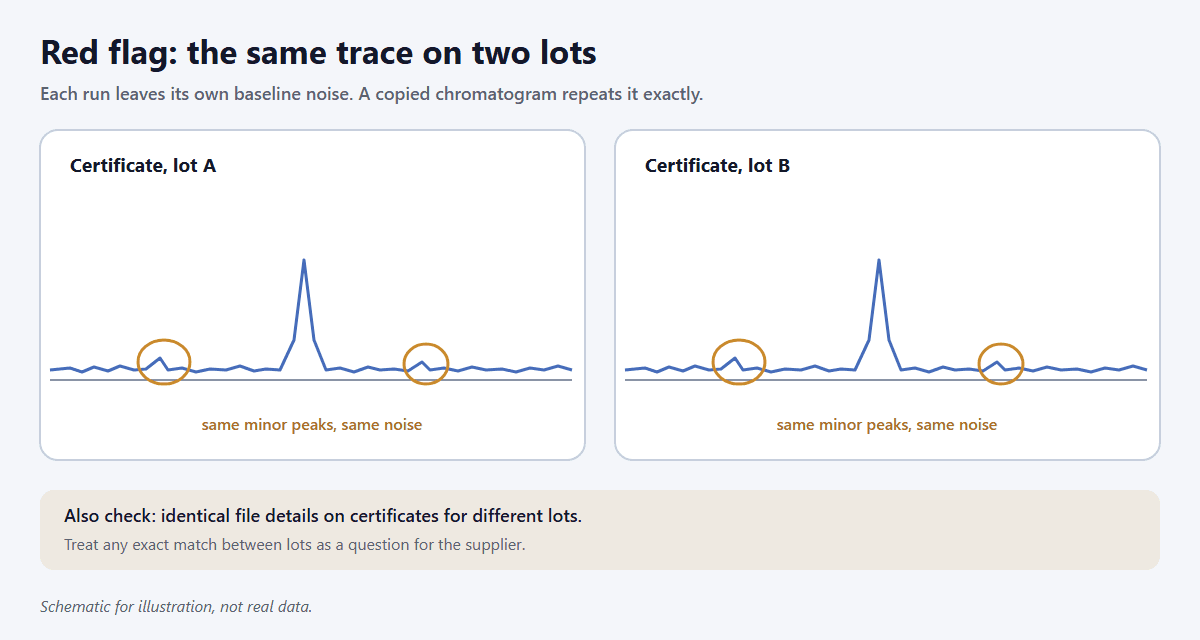
A reused chromatogram, with identical baseline noise, minor peaks or file details on certificates for different lots.
No laboratory named, or one that cannot be found at its stated address.
An accreditation logo with no body or certificate number behind it.
A purity figure with no method, or with no identity result beside it.
A report the named laboratory will not confirm.
Our guide to spotting a fake COA sets out most of these patterns in more depth.
Holding Every Supplier to the Same Standard
A checklist is only useful if it applies to every supplier, including this one. Every step above works from documents a reader can open, a laboratory a reader can look up, or a vial a reader can send away.
Janera Science lists its compounds on our lab results page. Where a certificate is posted, it opens from that compound's row, and its lot and strength can be checked against the row and your vial. Where none is posted, the row reads "COA Unavailable".
A researcher who runs these checks on us and finds a gap should tell us. That is the purpose of publishing documents that can be checked.
Frequently Asked Questions
How can I verify peptide purity from a supplier?
Read what the purity figure measures, match the certificate's lot number to your vial, check the laboratory's accreditation scope, and look for a mass spectrometry identity result. For the strongest evidence, send a sealed vial to an accredited laboratory you choose.
What does 99 percent purity mean on a peptide certificate?
It means the main peptide peak is 99 percent of the peak area the HPLC detector saw. Counter-ions, water and other non-peptide content are measured separately, so the share of the material that is actually peptide can be noticeably lower. In a theoretical worked example published by USP scientists, material of about 99 percent HPLC purity came to 0.91 to 0.92 mg of peptide per mg once non-peptide content and water were taken out (McCarthy et al., 2023).
How do I get a peptide lab tested?
Buy a vial through the normal checkout, keep it sealed and record its lot number. Send it to an ISO/IEC 17025 accredited laboratory whose scope covers HPLC purity and mass spectrometry, and ask for the chromatogram and spectrum along with the figures.
How do I check whether a laboratory is ISO/IEC 17025 accredited?
Find the accreditation body and certificate number on the report, confirm the body is in ILAC's signatory list for ISO/IEC 17025 testing, then check that the laboratory's scope lists your method, since programmes such as NIST's NVLAP accredit for specific tests (NIST).
Is a third-party certificate of analysis enough on its own?
It is strong evidence about the sample the laboratory received. Where the laboratory did not take the sample itself, ISO/IEC 17025 requires the report to state that the results apply to the sample as received (ISO/IEC 17025:2017, clause 7.8.2.2). Whether that sample represents your lot is what independent retesting answers.
Does a research use only label change what verification is needed?
No. A research use only label states what the seller says the product is for, and it does not change what is in the vial. FDA's definition of intended uses in its labeling regulations looks to the objective intent of the persons legally responsible for the labeling. That intent may be shown by their expressions, the design or composition of the article, or the circumstances surrounding its distribution, and the regulation gives labeling claims, advertising matter and oral or written statements as examples (21 CFR 201.128). Labeling claims are one source of that evidence among several. Verification is a separate question about the material, and our guide to what Research Use Only means covers the label itself.
Key Takeaways
HPLC purity is an area percentage of what the detector saw. Counter-ions, water and other non-peptide content are measured separately, so peptide content is a separate figure.
A certificate is evidence for one lot, so its lot number has to match the vial.
ISO/IEC 17025 accreditation covers specific tests, so check the scope for your method.
Purity and identity are different questions. Look for an observed mass beside the expected mass.
Independent peptide lab testing of your own sealed vial is the one check that tests the material directly.
All Janera Science compounds are supplied strictly for in-vitro laboratory research use only. They are not intended for human or veterinary use, and are not intended to diagnose, treat, cure, or prevent any disease. The statements made on this website have not been evaluated by the U.S. Food and Drug Administration.
Review the Documentation
Posted certificates open from each compound's row on the lab results page.